For tapas and small plates restaurants across Australia, adopting AI can be a practical way to lift efficiency, reduce costs and deliver better guest experiences, and this post will unpack how that works in practice: from why AI is a strategic advantage for small-format dining through ways to optimise bookings, manage waitlists and increase table turnover, to delivering personalised guest interactions and tailored menu recommendations that drive higher spend; we also look at how AI can streamline kitchen workflows and ingredient forecasting to cut waste and labour pressure, and how targeted local marketing powered by AI can bring repeat business and lift off-peak trade; importantly, you will see how AiDial’s voice platform can handle phone orders, take bookings and capture leads seamlessly while integrating into front- and back-of-house systems, all underpinned by rigorous data security and compliance because customer interactions and records are processed and stored exclusively on Australian soil, ensuring trust and regulatory alignment; practical implementation pointers and key takeaways will help restaurateurs decide which steps to prioritise next.
Why AI Matters for Tapas and Small Plates Restaurants
Tapas and small plates venues operate on intensity of service and memorable moments, so guests expect speed, personalised recommendations and seamless booking options even before they walk in. AI helps deliver that consistency at scale by automating routine touchpoints, from answering phone enquiries to handling last-minute bookings and capturing contact details for repeat business. For owners this means fewer missed calls, fewer double bookings and more opportunities to convert enquiries into covers without adding front-of-house headcount. Integrating voice AI allows venues to present a friendly, reliable presence 24/7 while maintaining the human warmth that defines small-plates hospitality. Choosing a solution with Australian Data Sovereignty, such as AiDial, ensures guest interactions and contact data are processed and stored onshore, which builds trust with customers and simplifies compliance with local privacy and hospitality standards.
Staffing is one of the biggest cost and operational challenges for small restaurants, where peak shifts require everyone to multitask and turnover is high. AI can ease that pressure by taking on predictable, repeatable duties that otherwise distract skilled staff from guest-facing service and food quality. Automated call handling, lead capture and reservation confirmations reduce the load on busy hosts while improving accuracy and reducing human error that leads to wastage or unhappy guests. The real business outcome is more efficient labour allocation, lower overtime, and a platform for consistent service during demand spikes or staff shortages. When these voice and AI systems adhere to Australian Data Sovereignty, operators benefit from onshore support and secure handling of employment-related recordings and customer data, protecting the business and its people.
In a small-format restaurant every cover counts, so decisions need to be fast and evidence-based. AI transforms disparate signals — phone enquiries, online orders, walk-in patterns and POS data — into actionable insights that help optimise menu mix, pricing and table sequencing. For example, understanding which small plates drive incremental spend or which time slots attract longer dwell times allows operators to tailor specials and staffing to maximise revenue per square metre. A voice-first provider like AiDial captures and structures phone-based leads and preferences into your analytics flow, improving marketing ROI and guest retention. Crucially, with Australian Data Sovereignty, this business intelligence stays onshore, reducing regulatory risk and giving owners confidence that their customer and operational data is secure, auditable and available when they need it.
Optimising Reservations, Waitlists and Table Turnover with AI
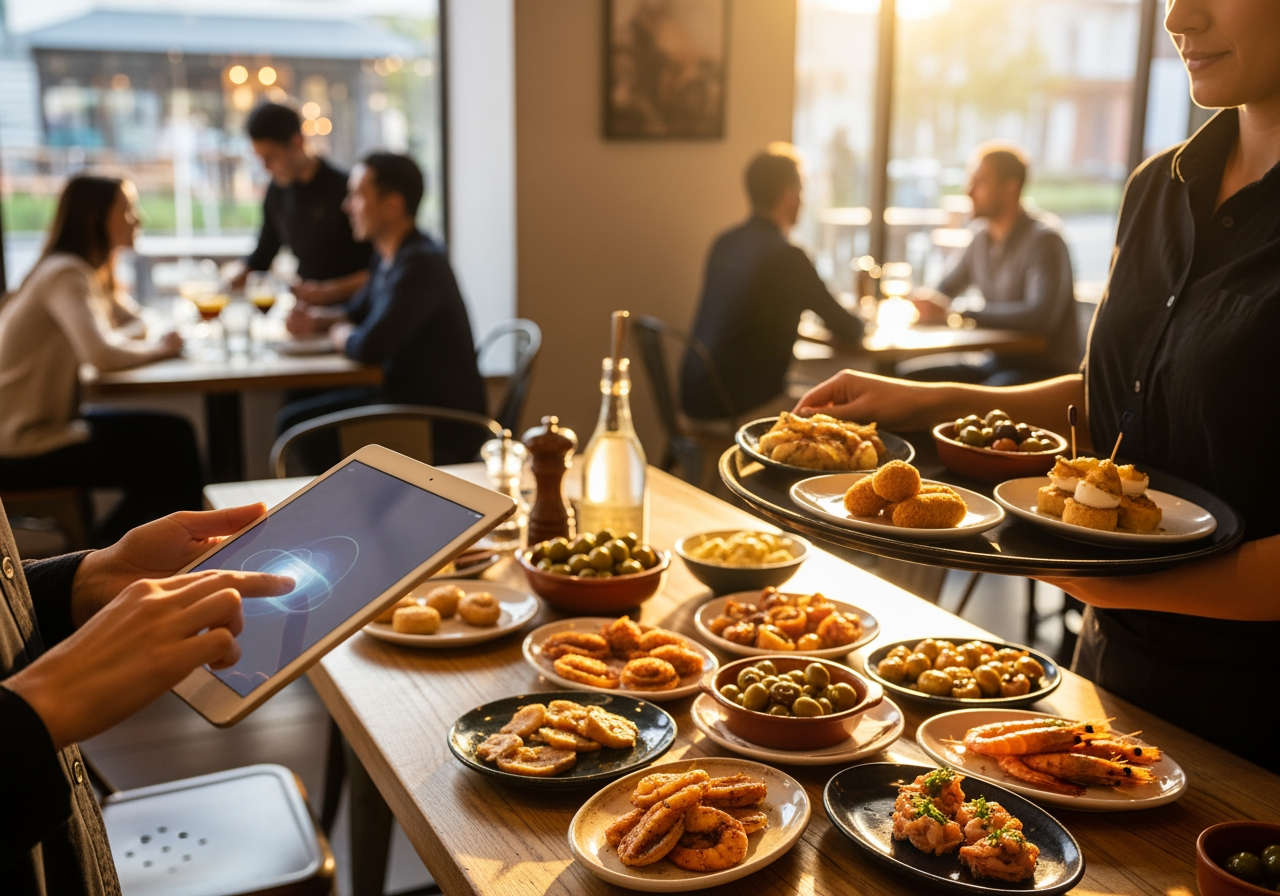
AI-driven reservation systems change how tapas and small plates venues manage scarce seating by applying dynamic table allocation and demand-aware booking rules. Instead of fixed time slots, the system predicts realistic dining durations based on party size, typical plate sharing behaviour and historical service patterns, then recommends optimal booking windows that maximise covers without rushing guests. For owners and managers that means higher revenue per service, fewer empty seats during peak times and a smoother flow for front-of-house staff who can focus on service rather than firefighting logistics.
Waitlist and guest communications are where AI delivers immediate operational relief. A smart waitlist estimates turn times in real time, offers accurate ETA updates and automates confirmations or callbacks via SMS and phone using AiDial’s voice platform, freeing staff from constant door and phone management. AI can also flag high no-show risk bookings and suggest deposit or confirmation steps, while AiDial captures missed-call leads and booking enquiries so no opportunity is lost. The result is fewer walkaways, lower labour overhead for gatekeeping and a better guest experience through timely, personalised communication.
Behind the scenes, AI ties reservation data to POS, kitchen and floor-plan information so managers can measure turnover by table type, menu item and service period and adjust rostering or menu pacing to remove bottlenecks. Predictive analytics help set sensible overbooking levels for busy nights and flag when additional kitchen support is needed to protect food quality and speed. Crucially, when these systems run on AiDial with Australian Data Sovereignty there is the assurance that guest and booking data are processed and stored on Australian soil, supporting compliance with privacy obligations and building trust with customers who expect their details to stay local – a tangible advantage for hospitality operators concerned about security and regulatory risk.
Personalised Guest Experiences and Menu Recommendations
Tapas and small plates venues rely on swift, friendly interactions; AiDial’s conversational voice platform lifts those moments into personalised experiences by capturing guest preferences during calls and bookings. When a guest rings to reserve or place an order, AiDial can record seating preferences, dietary requirements and flavour likes without burdening busy floor staff, then surface those notes to hosts and servers in real time. This reduces errors, speeds service and ensures guests feel recognised on arrival. Because AiDial processes and stores that information exclusively in Australia, managers can confidently build rich guest profiles while meeting local privacy and compliance expectations. The result is a smoother front-of-house, fewer food-allergy incidents, higher guest satisfaction scores and staff freed to focus on hospitality rather than manual note-taking.
AI-driven recommendations turn casual bookings into curated dining experiences by suggesting complementary plates, shareable pairings and beverage matches based on guest history, party size, time of day and even weather or local events. AiDial can deliver these suggestions naturally over the phone or feed them into your POS and staff apps so servers receive intelligent prompts to upsell high-margin options at the right moment. For small-plate concepts where cross-selling increases average spend per head, this capability drives measurable revenue gains while preserving the informal dining vibe. With all recommendation logic and customer signals kept on Australian soil, operators maintain trust and meet regulatory obligations, enabling more confident experimentations with menu engineering and targeted offers that lift yield without compromising guest privacy.
Personalisation scales when data becomes actionable insight: AiDial aggregates preferences into privacy-safe customer profiles that power loyalty offers, tailored promotions for off-peak nights and smart menu tweaks based on real demand. These profiles help predict repeat-visit windows, tailor special-event invites and inform limited-time small-plate rotations that reduce waste by aligning supply with likely demand. Crucially for Australian operators, AiDial’s commitment to Australian Data Sovereignty means preference and transaction data never leaves the country, simplifying compliance with local privacy law and strengthening guest trust—essential for asking customers to share tastes and dietary needs. The outcome is a virtuous cycle of personalised service, higher return rates, reduced food waste and clearer ROI from targeted guest engagement.
Streamlining Kitchen Operations and Ingredient Forecasting
For tapas and small plates kitchens where portion sizes and menu rotation change regularly, AI can turn unpredictable service patterns into predictable workflows. Machine learning models ingest real time POS data, reservations and historic service peaks to generate practical prep lists and mise en place schedules that reduce ticket times and minimise last minute rushes. When the kitchen receives accurate, structured order and booking data from AiDial voice-enabled systems, those models gain an extra layer of precision, allowing chefs to stage dishes and allocate burners and pass space more efficiently, directly improving table turnover and guest satisfaction.
Ingredient forecasting for small plate concepts benefits from AI that understands seasonality, supplier lead times and local demand drivers such as nearby events or weather. Forecasting engines can suggest optimal par levels for delicate produce and perishable proteins, trigger automated purchase orders and highlight likely waste points before they occur. Because AiDial captures phone orders and booking changes in real time and feeds that data into forecasting workflows, purchasing becomes more accurate and waste is reduced, producing measurable cost savings on food spend and fewer stockouts during peak service.
Labour planning and on-shift tasking are also simplified with AI that recommends roster adjustments, cross training and shift start times aligned to predicted service volumes. Automated checklists and dynamic prep windows help staff focus on high impact tasks and reduce overtime and stress in compact kitchens. Crucially, all operational and customer data used to drive these efficiencies can be processed and stored under Australian Data Sovereignty, which protects sensitive supplier, staff and guest information, ensures compliance with local privacy standards and gives Australian operators confidence that their operational intelligence remains within trusted local systems.
AI-Driven Local Marketing and Repeat Business
AI enables tapas and small plates restaurants to target customers at a hyperlocal level, converting nearby foot traffic and local communities into repeat trade. By analysing reservation patterns, walk-in volumes and local events AI identifies high-value micro-markets such as nearby office precincts, university campuses or nightlife strips and recommends precise offers for each segment. Dynamic pricing and time-limited deals can be deployed to boost weekday lunches or late-night snacks, while geofencing and predictive timing ensure messages hit at the moments customers are most likely to act. Integrating AiDial voice capture means phone enquiries and leads are immediately attributed to campaigns, reducing ad waste and closing the loop between marketing and bookings. Crucially all customer interactions and campaign data are processed and stored on Australian soil, protecting privacy, ensuring compliance with the Privacy Act and building trust with local guests who expect secure handling of their information.
AI-driven loyalty programs personalise re-engagement at scale so small-format restaurants convert occasional diners into loyal regulars. Machine learning segments patrons by visit frequency, spend, menu preferences and occasion type, then triggers tailored outreach such as menu suggestions, birthday incentives or tasting-event invites. Automation handles timing and channel selection across SMS, email and automated voice outreach, reducing staff workload while keeping the experience highly personal. AiDial voice solutions capture consent and customer preferences during calls, feeding real-time updates into the loyalty engine for immediate use. The onshore data handling that comes with Australian Data Sovereignty means these loyalty profiles are secured within Australia, simplifying compliance and demonstrating respect for customer data. For restaurateurs this delivers higher lifetime value, fewer no-shows through timely reminders and lower marketing cost per retained customer.
Understanding which campaigns drive bookings and repeat visits is essential for optimising marketing spend. AI attribution models connect the dots between discovery channels, paid ads, social posts and phone enquiries to show true return on investment and customer lifetime value. Incorporating AiDial voice interactions enriches attribution by converting call outcomes into structured data such as booking codes, campaign source and lead scores, so every call is measurable and actionable. Predictive analytics can forecast which customers are most likely to return after a specific offer and which segments need re-engagement, enabling smarter budgeting and staffing decisions. With all analytics and call data processed onshore under Australian Data Sovereignty, restaurants avoid cross-border data risk, accelerate reporting and maintain a strong compliance posture that reassures customers and partners while delivering demonstrable improvements in repeat bookings and reduced customer acquisition cost.
AiDial Voice Solutions for Phone Orders, Bookings and Lead Capture
AiDial’s voice platform turns busy phone lines into a reliable revenue channel for tapas and small plates restaurants by handling phone orders, taking bookings and answering common enquiries with natural, conversational AI. The system captures booking details, party size, special requests and preferred times, then writes directly into your reservation system or POS so availability is accurate and the kitchen can plan ahead. By reducing hold times and freeing staff from repetitive phone tasks, restaurants see faster service, higher conversion of callers into covers and lower labour costs during peak periods.
Beyond bookings, AiDial is built to capture valuable leads and guest preferences that drive repeat business. The voice agent records customer contact details, dietary needs, celebration notes and marketing opt-ins, and can trigger confirmation SMS or email reminders and automated deposit requests for large groups to cut no-shows. Those captured leads synchronise with your CRM for targeted local campaigns and personalised offers—helping small-format venues lift off-peak trade and increase average spend through timely, relevant follow-up.
Crucially for Australian operators, AiDial processes and stores all voice and customer data on Australian soil, giving you stronger security, easier compliance with local privacy requirements and greater trust from guests worried about where their information goes. Local data residency also means faster support and smoother integration with Australian reservation platforms and payment flows, so you get a secure, locally-supported voice solution that delivers measurable outcomes: reduced costs, improved guest experience and more reliable lead capture.
Data Security and Compliance: Australian Data Sovereignty in Hospitality AI
For tapas and small plates restaurants, customer interactions generate a lot of sensitive data: bookings, phone orders, dietary notes, loyalty profiles and sometimes payment tokenisation details. Keeping that data stored and processed on Australian soil reduces legal and operational risk because it aligns with the Privacy Act and the Notifiable Data Breaches scheme, and avoids complications from foreign jurisdictions with different access rules. Australian Data Sovereignty means restaurants can confidently use AI to personalise offers and streamline operations without exposing guest information to offshore servers subject to other nations’ surveillance or disclosure laws. For operators, the practical benefits include lower latency for voice systems, more predictable uptime, and a clearer pathway for responding to regulatory enquiries or customer requests about their data. Choosing a locally hosted AI voice partner like AiDial makes it straightforward to meet both guest expectations around privacy and the compliance obligations that come with handling personal and transactional data.
Implementing AI in hospitality is not just about capability, it is about controls. Effective compliance combines technical and administrative safeguards: encryption in transit and at rest, role based access controls, detailed audit logs, defined retention policies and an incident response plan tailored to hospitality scenarios. For phone orders and bookings, tokenisation of payment details and separation of customer identifiers from transactional records minimise exposure. Regular penetration testing, vulnerability scanning and independent audits such as ISO 27001 or SOC assessments provide assurance to managers and franchise owners. Staff training is equally vital so front of house and back of house teams understand data handling and consent practices. AiDial’s platform is designed with these measures in mind and keeps processing within Australia, simplifying breach notification obligations and speeding up remediation when issues arise, which in turn protects brand reputation and guest trust.
Many restaurants rely on a stack of systems: POS, reservation platforms, loyalty providers and marketing tools. Each integration is a potential data flow that needs mapping and contractual protection. When selecting AI vendors, prioritise clear data residency commitments, transparent sub processor lists and contractual clauses that prevent unauthorised cross-border transfers without explicit consent and appropriate safeguards. Use APIs that support scoped access, token based authentication and allow selective synchronisation so only necessary fields leave a system. For payment-related flows, rely on PCI DSS compliant tokenisation and avoid storing raw card data. Local cloud hosting and Australian based sub processors reduce legal complexity and make incident coordination simpler. AiDial supports integrations with common hospitality systems while maintaining Australian Data Sovereignty, helping restaurants keep control of guest data, demonstrate regulatory compliance and deliver personalised experiences without compromising security or trust.



Conclusion and Key Takeaways
AI offers practical, revenue-focused advantages for tapas and small plates restaurants: optimise reservations and waitlists to increase table turnover, personalise guest experiences and menu recommendations to lift spend and loyalty, and streamline kitchen operations and ingredient forecasting to reduce waste and improve margins. AI-driven local marketing and automated follow-ups capture repeat business, while AiDial voice solutions make phone orders, bookings and lead capture seamless—turning missed calls into confirmed covers and measurable revenue gains. Crucially, keeping all voice and customer data on Australian soil through AiDial’s Australian Data Sovereignty ensures security, regulatory compliance and customer trust, which are essential for hospitality operators handling guest information and payment details.
To build on these strategies, combine menu experimentation with data insights from AI—see Tapas and Small Plates Menu Ideas for Australian Restaurants for inspiration—and align AI-driven customer and call strategies with your long-term plans as described in Business Exit Planning for Australian SMEs: AI Call Strategy. If you want to see how Australian-hosted AI voice solutions can improve efficiency, reduce costs and enhance guest experience at your venue, Contact Us for a Consultation or Book a Demo with AiDial today.