Court reporting in Australia presents growing pressures around mounting caseloads, exacting accuracy requirements and the need to deliver transcripts and records faster without compromising confidentiality, and modern AI voice solutions address these challenges by dramatically improving transcription accuracy and speed through advanced speech recognition and contextual understanding, while enabling real-time reporting and smoother courtroom workflows that keep hearings moving and legal teams informed. For firms handling sensitive matters, keeping audio and transcript processing on Australian soil is essential for meeting regulatory obligations, protecting privileged communications and maintaining client trust, which is why an Australian-hosted AI voice platform provides both the technical performance and the jurisdictional assurances required for confidential legal reporting. The right solution for court reporters and legal practices must also be straightforward to integrate with existing case management and evidence systems, scale to support firm growth or peak workloads, and be practical to implement with minimal disruption to established processes. Beyond operational improvements, deploying an Australian-hosted AI voice service delivers measurable cost savings and resource optimisation by reducing manual transcription hours and turnaround times, freeing court reporters and lawyers to focus on higher-value work and improving client service through faster, more reliable access to accurate records. By combining speed, accuracy, secure local data handling and pragmatic integration and scalability, this new generation of voice technology offers a compelling way for Australian firms to modernise reporting workflows while safeguarding the confidentiality and integrity of legal information.
Court Reporting Challenges for Australian Firms
Australian court reporting teams are stretched by growing caseloads, compressed timelines and the need to deliver high-quality transcripts faster than ever. Manual transcription and review workflows struggle to keep pace with the volume of hearings and the proliferation of remote or hybrid appearances, leading to backlogs, overtime costs and an increased risk of errors. Recruiting and retaining trained reporters is also challenging, especially across regional jurisdictions. These pressures drive a need to automate repetitive tasks, accelerate turnaround and refocus skilled staff on quality control and complex legal interpretation. An Australian-hosted AI voice platform such as AiDial can help by automating initial transcription, providing rapid draft transcripts and supporting reporter review workflows, improving throughput while ensuring that sensitive audio and transcript processing remains on Australian soil to meet local security and compliance expectations.
Court reporting demands near-perfect accuracy, precise speaker attribution and a watertight chain of custody for audio and records. Any transcription error, misattributed statement or breach of confidentiality can have serious legal and reputational consequences for firms and the courts. Maintaining privileged communications and meeting evidentiary standards means storage, access controls and audit trails must be robust and provable. International cloud providers can introduce uncertainty around where data is processed and stored, complicating compliance with Australian rules and client confidentiality obligations. An Australian-hosted AI solution like AiDial addresses these concerns by keeping processing and storage within national borders, supporting secure audit trails, role-based access and features tailored for legal terminology, so firms can achieve faster, more accurate transcripts without compromising evidentiary integrity or client trust.
Many law firms and court registries operate with a patchwork of legacy recording systems, case management software and disparate file formats, which creates integration headaches and operational inefficiencies. Poor audio quality from remote hearings, multiple speakers and variable internet conditions further degrade transcription performance if systems are not designed for resilience. Scalability is also a concern: sudden spikes in hearings or major cases require elastic capacity and predictable costs. Additionally, firms must meet regulatory and cybersecurity expectations that favour local data handling. AiDial’s Australian-hosted AI voice platform offers APIs and connectors built to integrate with existing court and practice management systems, scalable cloud infrastructure that remains within Australia, and audio-processing capabilities tuned for real-world courtroom conditions, reducing IT complexity while preserving compliance and data sovereignty.
How AI Voice Technology Improves Transcription Accuracy and Speed
Modern AI voice engines combine advanced automatic speech recognition with contextual language models tuned for legal settings, which directly improves transcription accuracy for court reporting. These systems use domain specific vocabularies and named entity recognition to correctly capture legal terminology, witness names and case references, while speaker diarisation differentiates between judges, counsel and witnesses to preserve the integrity of the record. Training on Australian accents and courtroom phrasing further reduces errors that generic models often make, and features like automatic punctuation and timestamping remove common sources of post-editing, lifting both the quality and reliability of transcripts.
Speed gains come from low latency streaming and real-time processing that deliver usable transcripts while hearings are still underway, enabling clerks and reporters to flag issues immediately instead of catching up afterwards. AI can produce an initial high-quality draft that human reporters can rapidly review and correct, dramatically shortening turnaround times compared with fully manual transcription. Built-in workflow tools such as live editing, automated quality checks, redaction options and export to legal templates streamline the end-to-end process so firms can deliver finalised transcripts to courts and clients faster without sacrificing accuracy.
AiDials Australian-hosted AI voice solution combines these technical advantages with Australian data sovereignty, meaning audio and derived transcripts are processed and stored on local infrastructure. That local processing not only supports compliance and confidentiality obligations but also allows models to be continuously optimised on Australian legal data, improving recognition of regional accents, legal conventions and case types over time. The result for firms is measurable: fewer corrections, reduced labour hours, faster invoicing and a more trustworthy service proposition for clients handling sensitive matters, all backed by the assurance that privileged material never leaves Australian jurisdiction.
Real-Time Reporting and Streamlined Court Workflows
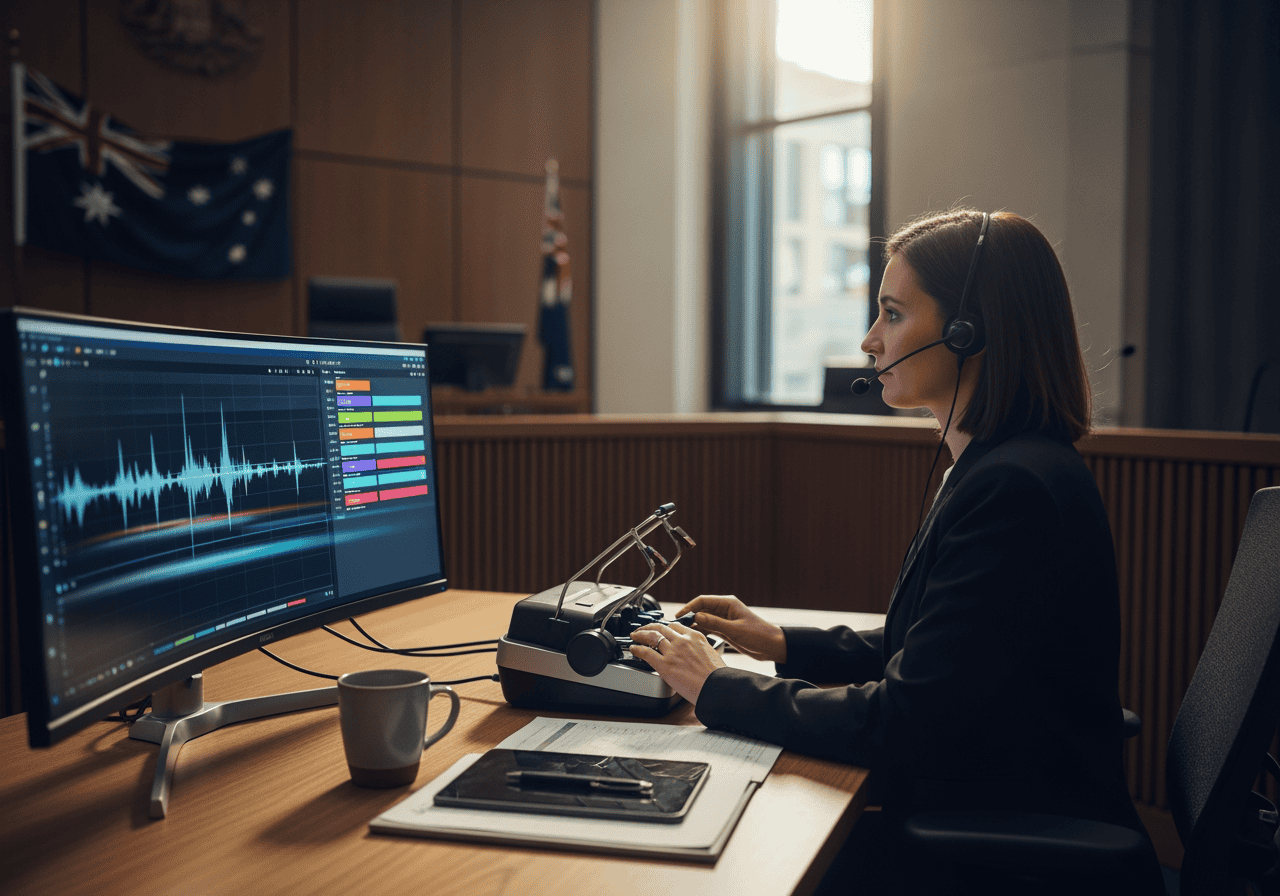
Real-time transcription transforms courtroom flow by delivering accurate captions and near-instant transcripts as hearings unfold, helping magistrates, counsel and participants follow proceedings without delay. Advanced speech recognition paired with speaker diarisation and timestamps means every submission is captured contextually, so court reporters can focus on quality checks rather than verbatim capture. For hybrid or remote hearings, live transcripts and display feeds reduce misunderstandings, speed decision-making and improve accessibility for interpreters and jury members with hearing needs. AiDial’s Australian-hosted platform ensures this live processing happens on local infrastructure, preserving confidentiality and compliance while enabling rapid access to records. The result is fewer interruptions, faster adjournments and a smoother hearing rhythm that keeps caseloads moving and reduces the administrative backlog associated with delayed transcripts.
Streamlined courtroom workflows combine automated transcription with collaborative editing tools that let court reporters, counsel and clerks annotate, tag and correct content in a shared environment. Human-in-the-loop workflows prioritise reporter review for legal nuance and privilege checks while automation handles routine time-stamping, speaker identification and formatting. Automated workflows can route drafts to the right reviewer, apply redaction flags, and push finalised transcripts into case folders or e-filing queues, cutting manual hand-offs and turnaround times. By integrating these features, AiDial helps firms optimise resource use, reduce overtime for reporting staff and maintain high standards of accuracy and auditability. With processing and collaboration anchored on Australian servers, sensitive edits and privileged communications remain protected under local data sovereignty rules, reinforcing client trust during every stage of document preparation.
Efficient workflows extend beyond transcription to include seamless integration with case management systems, e-filing platforms and court registers, so finalised records are delivered where they are needed without duplicative admin. AiDial provides secure APIs and export options that preserve metadata, timecodes and redaction history, ensuring the evidentiary integrity required for appeals and audits. Built-in role-based access, encryption at rest and in transit, and comprehensive audit trails support compliance with Australian legal obligations and firm policies, reducing risk in the chain of custody for sensitive material. Local hosting under Australian data sovereignty further minimises exposure to foreign legal regimes and strengthens compliance with privacy and professional privilege expectations. Together, these capabilities shorten the path from hearing to archived record, lower costs associated with rework, and improve client service through faster, more reliable delivery of certified transcripts.
Why Australian Data Sovereignty Matters for Confidential Legal Reporting
For court reporting and legal transcription, confidentiality and privilege are not optional— they are fundamental obligations. Australian law firms and court reporters operate under the Privacy Act, the Notifiable Data Breaches scheme and strict evidentiary and disclosure rules that make control over where audio and transcripts are processed critically important. When data crosses borders it can become subject to foreign laws or access requests, complicating chain of custody and increasing the risk of inadvertent disclosure of privileged material. Keeping speech processing and storage firmly on Australian soil helps ensure privileged communications remain protected under domestic legal frameworks and simplifies compliance with court orders and client confidentiality requirements.
From a security and risk-management perspective, Australian Data Sovereignty reduces exposure to extraterritorial access, improves incident response times and makes security governance more straightforward. Local hosting means encryption keys, access logs and audit trails remain within Australian jurisdiction, enabling faster forensic investigation and clearer accountability if an incident occurs. It also allows law firms to apply consistent retention and destruction policies that reflect legal obligations and client instructions, rather than relying on offshore providers whose policies or legal obligations may differ. An Australian-hosted AI voice platform therefore offers a tangible reduction in legal and operational risk for sensitive matters.
Beyond compliance and security, data residency delivers measurable business benefits: stronger client trust, fewer contractual barriers to using AI transcription services, and a lower administrative burden when responding to discovery or disclosure requests. For firms that need to scale transcription services across multiple matters and jurisdictions, an Australian-hosted solution simplifies governance and reduces the likelihood of costly disputes over data handling. AiDial’s Australian-hosted AI voice platform combines advanced speech recognition with strict Australian Data Sovereignty, giving legal teams the confidence to speed up reporting and optimise workflows while keeping sensitive material protected under local law.
Why AiDial Australian-Hosted AI Voice Solution Is the Right Fit
AiDial is engineered to meet the exacting accuracy requirements of court reporting, with speech recognition models tuned to legal vocabulary, complex syntax and jurisdictional phrasing common in Australian proceedings. Features such as speaker diarisation, timestamping and intelligent punctuation reduce manual correction time, while contextual language models improve recognition of proper nouns, case citations and technical evidence descriptions. The result is higher first-pass accuracy and faster turnaround for certified transcripts, allowing reporting teams to handle larger caseloads without sacrificing quality. For firms, that translates into measurable productivity gains, lower outsourcing costs and improved client service through quicker delivery of reliable records. Because AiDial is focused on practical courtroom outcomes, the platform supports export formats and annotation workflows that align with court filing requirements and paralegal workflows, ensuring transcripts are ready for use by solicitors, barristers and court staff with minimal post-processing.
AiDial’s Australian-hosted solution places a premium on data sovereignty, ensuring all audio, intermediate processing and final transcripts are stored and processed exclusively on Australian soil. This approach simplifies compliance with the Privacy Act and the Australian Privacy Principles, helps protect privileged communications and reduces exposure to foreign legal regimes that could otherwise affect client confidentiality. By keeping data local, AiDial minimises the legal and reputational risks of cross-border data transfer and supports chain-of-custody requirements vital for evidentiary integrity. The platform also implements industry-standard security controls such as encryption in transit and at rest, role-based access, secure audit logs and rigorous access controls, providing courts and firms with transparent controls and traceability that build trust with judges, clients and regulatory bodies.
AiDial offers deployment flexibility that fits the varied needs of Australian court reporting teams, from cloud-hosted solutions on Australian data centres to hybrid or on-premise arrangements where required. Robust APIs and native connectors make integration with practice management systems, transcript management tools and court portals straightforward, enabling automated workflows that reduce administrative overhead. The platform is built to scale, supporting single reporters through to large-scale registry operations, with enterprise-grade SLAs and disaster recovery planning tailored for court continuity. Critically for Australian firms, AiDial provides local support and implementation teams who understand courtroom workflows and compliance expectations, delivering training, customisation and ongoing optimisation. That local expertise accelerates adoption, lowers total cost of ownership and ensures the solution continuously adapts as caseloads, rules and technology evolve.
Integration, Scalability and Implementation Considerations for Firms
Successful integration starts with compatibility across the courtroom technology stack and the systems legal teams already rely on. AiDial offers secure APIs and prebuilt connectors that integrate with major case management platforms, evidence management systems and video conferencing tools, enabling real-time audio capture, automated transcript ingestion and synchronised metadata such as timestamps, speaker labels and file references. By supporting standard formats and custom legal lexicons, AiDial reduces manual rework and preserves courtroom workflow integrity while ensuring all audio and transcript processing remains on Australian soil to meet client confidentiality and regulatory expectations.
Scalability is essential for firms facing variable caseloads and complex multi-day hearings, so architecture choices must deliver elastic capacity without compromising latency or security. AiDial’s Australian-hosted, cloud-native platform can scale horizontally to handle peak transcription loads and concurrent hearings, while also offering dedicated or hybrid deployments for firms that require isolated environments or on-premise integration. Built-in features such as automated load balancing, geographically local disaster recovery and role-based access controls help maintain performance and compliance as volumes grow, with service levels and data retention policies aligned to Australian legal requirements.
Implementation should be phased and results-driven to secure user adoption and measurable benefits. Start with a pilot focused on specific hearing types or reporting teams, tune speech models with firm-specific vocabularies and establish QA feedback loops so accuracy improves quickly in production. AiDial supports onsite and remote onboarding, tailored training for reporters and docket clerks, and ongoing optimisation backed by local support and monitoring, enabling firms to track metrics such as turnaround time, cost per transcript and error rates, and to scale rollouts confidently across practice groups and jurisdictions within Australia.
Cost Savings, Resource Optimisation and Improved Client Service
Implementing AiDial’s Australian-hosted AI voice solution delivers immediate and ongoing cost savings by automating time-intensive transcription tasks that traditionally require substantial manual labour or expensive offshore outsourcing. Firms see predictable expenditure through subscription-based pricing and reduced overtime and temp staffing needs during peak caseloads. Eliminating the need to ship audio files overseas also cuts third-party vendor fees and mitigates hidden compliance costs associated with cross-border data transfers. Storage and retrieval costs fall as searchable, indexed transcripts replace bulky physical archives, while faster first-draft accuracy reduces costly revision cycles. Because all processing and storage remain on Australian soil under AiDial’s data sovereignty model, there is reduced exposure to regulatory penalties and reputational risk, further improving total cost of ownership and delivering a clear, measurable return on investment for court reporting teams and legal practices.
By automating routine transcription and verbatim capture, AiDial allows court reporters and legal staff to focus on high-value activities such as quality assurance, complex legal editing, courtroom attendance and client liaison. Workflows become leaner when AI provides accurate first drafts, time-stamped indexing and speaker attribution, which speeds review and accelerates case preparation. Integration with case management systems enables transcripts to flow into existing matter files without manual re-entry, reducing administrative overhead and transcription bottlenecks. Because AiDial is trained on Australian accents, legal terminology and courtroom conventions and operates entirely within Australia, teams benefit from models that reliably understand local speech patterns while keeping confidential material onshore. This combination of workforce optimisation and onshore processing results in faster turnaround, improved staff morale and a more resilient reporting operation.
Faster, more accurate transcripts combined with secure, Australian-based processing translate directly into better client service and a stronger market proposition for court reporting firms. Clients receive quicker delivery windows, searchable digital records and transparent audit trails that demonstrate chain of custody and compliance with Australian privacy and evidence standards. The assurance that audio and transcript data never leave Australia builds trust with clients handling sensitive matters and reduces friction when meeting regulatory or court disclosure obligations. Scalability during spikes in caseloads means firms can maintain consistent service levels without compromising confidentiality or accuracy. By promoting secure, onshore AI-enabled reporting capabilities, firms can differentiate on speed, reliability and compliance, turning operational improvements into tangible client benefits and new business opportunities.



Conclusion and Key Takeaways
AiDial’s Australian-hosted AI voice solutions help court reporting teams deliver faster, more accurate transcriptions, enable real-time reporting and streamline courtroom workflows to reduce turnaround times, lower operating costs and free skilled staff for higher-value legal work. Crucially, Australian Data Sovereignty means all voice processing and storage stays on Australian soil, giving firms stronger confidentiality, easier compliance with local regulations and greater client trust when handling sensitive legal reporting.
These solutions are designed to integrate and scale with existing case management and document systems to optimise resources and improve client service across matters including arbitration and investigations; learn how our approach supports faster dispute resolution in Arbitration Services for Faster Business Dispute Resolution and accelerates casework in Private Investigation: AI Voice Tools for Faster Casework, while maintaining secure records as outlined in Document Management: Secure Local Solutions for Australia. To discuss how AiDial can reduce costs, improve accuracy and keep your legal data local, Book a Demo or Contact Us for a Consultation.