Artificial intelligence is reshaping how communities prepare for and respond to emergencies by enabling smarter planning, faster alerts and more efficient use of scarce resources; this post explores how data-driven mapping of local hazards and vulnerable groups can inform targeted preparedness, how real-time alerts and two-way communication keep residents safe during incidents, and how automating emergency call handling and resource coordination with AiDial reduces response times, lowers operational costs and frees up emergency services for higher-value tasks; drawing on Australian community examples, we illustrate practical outcomes while emphasising the critical advantage of keeping all data processed and stored on Australian soil to meet security and compliance expectations and build public trust, and we outline practical approaches to responsible implementation that combine governance, privacy safeguards and community engagement so councils and service providers can confidently build resilient local systems with AiDial.
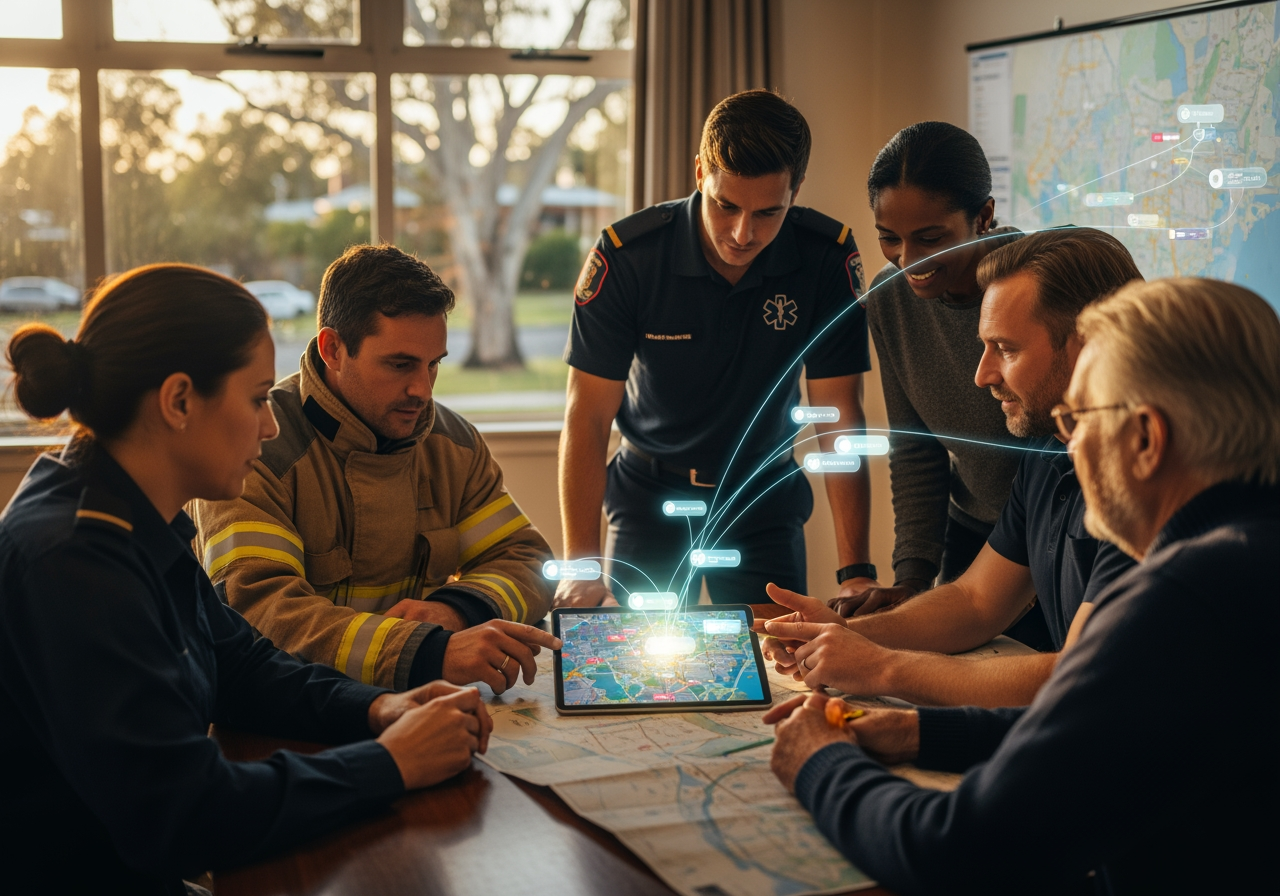
The Role of AI in Strengthening Community Emergency Response
AI strengthens community emergency response by analysing diverse local datasets to produce predictive situational awareness that authorities can act on early. Machine learning models fuse weather forecasts, river gauge readings, CCTV feeds, traffic telemetry and community reports to forecast where incidents are likely to occur and which neighbourhoods are most at risk. For councils and emergency services this means targeted pre-deployment of crews, strategic placement of temporary signage and better stockpiling of supplies, which reduces response times and lowers operational costs. AiDial complements predictive systems by integrating AI-driven voice channels that automatically notify priority contacts and pre-emptively triage affected residents, ensuring scarce human resources are directed to highest-value tasks. Crucially, when predictive analytics and voice communications are processed and stored under Australian Data Sovereignty, local authorities preserve citizen trust, meet jurisdictional compliance and reduce legal risk associated with cross-border data transfers.
Effective emergency response depends on clear, timely two-way communication with residents; AI makes that communication scalable and personalised. Natural language understanding enables systems to send context-sensitive alerts and receive structured feedback from individuals about accessibility needs, evacuation intent or property damage, turning passive broadcasts into actionable situational intelligence. AiDial’s AI voice platform automates outbound calls and interactive voice response, captures responses in real time and flags priority cases for escalation, improving community safety while reducing admin overhead. The outcome for local government and emergency management teams is improved situational clarity, faster decision-making and better allocation of resources, delivering measurable efficiency gains and higher resident satisfaction. By keeping all interaction data within Australia, AiDial ensures communications comply with local privacy expectations and regulatory frameworks, preserving community trust in automated systems.
AI augments emergency response capacity by automating routine, repetitive tasks and by providing decision support that makes human teams more effective under pressure. Automated call triage, priority routing, and intelligent scheduling free up frontline staff to focus on complex rescue and clinical work, yielding cost savings and reducing burnout. Predictive dispatch algorithms recommend optimal resource mixes and routing to reduce response times, while AI-driven dashboards provide incident commanders with a consolidated operational picture. AiDial’s voice automation integrates seamlessly with dispatch and case-management systems, capturing caller intent and updating incident records without manual data entry, which accelerates workflows and improves record accuracy. Importantly, housing these operational datasets on Australian soil under AiDial’s Australian Data Sovereignty commitment keeps sensitive emergency information secure, simplifies compliance with audit and privacy requirements and strengthens inter-agency collaboration across state and local centres.
Mapping Local Risks and Vulnerable Groups with Data-Driven Insights
Effective mapping of local hazards and vulnerable groups starts with combining diverse data sources into a living geospatial picture. Local council records, emergency services incident logs, Bureau of Meteorology feeds, health and aged-care registries, utilities data and community surveys can be layered with demographic and housing information to reveal where risk and vulnerability overlap. Advanced analytics and risk-modelling translate these inputs into vulnerability indices and scenario maps, helping planners pinpoint high-risk streets, congregate living facilities, isolated households and culturally and linguistically diverse pockets that need bespoke preparedness strategies.
Those maps become operational tools when they drive targeted preparedness activities and prepositioned resources. Emergency services and community agencies can use mapped insights to design evacuation corridors, prioritise welfare checks and position temporary shelters or generators where they will serve the most people. For local governments and SEMS teams this targeted approach reduces wasted resources, shortens response times and improves outcomes for people who would otherwise be missed—for example older Australians living alone, renters in flood-prone units, or limited-English households who need translated communications and tailored support.
AiDial converts mapped intelligence into action through automated, data-driven outreach and coordination that respects Australian Data Sovereignty. By ingesting locally hosted geospatial and vulnerability datasets, AiDial triggers personalised voice calls, two-way check-ins and priority escalation workflows for identified cohorts while keeping all processing and storage on Australian soil to meet privacy and compliance obligations. That local data residency builds trust with councils and community organisations, simplifies adherence to Australian Privacy Principles and state regulations, and delivers measurable business outcomes such as lower operational costs, faster mobilisation of resources and higher rates of successful welfare checks during emergencies.
Real-Time Alerts and Communication to Keep Communities Safe
Effective real-time alerts start with precision. AI models can ingest live data feeds from weather bureaux, SES reports and local sensors to identify the exact suburbs or postcode pockets at risk and trigger tailored messages only to those residents. AiDial enables multichannel delivery so communities receive alerts by voice call, SMS, push notification and email depending on preference and the severity of the incident. Local processing and storage on Australian soil keeps latency low, which means faster dissemination and less risk of missed windows for evacuation or sheltering. For councils and emergency services this translates into measurable outcomes: fewer unnecessary mass alerts, clearer guidance to affected households, reduced call volume to emergency lines and improved staff efficiency. The cost efficiencies of targeted alerts also reduce wasteful communications spend while increasing community confidence that messages are timely and relevant.
Real-time communication must be a conversation not a broadcast. Two-way voice and messaging powered by AI lets authorities check whether residents are safe, request status updates from vulnerable individuals and gather on-the-ground reports that refine situational awareness. AiDial specialises in interactive voice responses and natural language understanding that can triage incoming replies, escalate urgent cases to human operators and update incident dashboards automatically. This feedback loop helps prioritise limited resources, reduce duplication of welfare checks and speed targeted welfare visits. For local emergency centres and community organisers the benefits are concrete: faster identification of people in immediate danger, fewer false positives consuming emergency responder time and improved record keeping for post-incident recovery. Importantly, with all processing kept within Australia, communities are more likely to opt in and trust that their responses are handled securely.
Communications during emergencies must reach everyone, including non-English speakers, people with hearing or sight impairment and culturally diverse communities. AiDial supports multilingual TTS, formatted SMS, phone-based captioning and simplified messages that adapt to recipient needs automatically. Delivering these capabilities from infrastructure housed and managed on Australian soil strengthens legal compliance and community trust, making it easier for councils and emergency services to meet privacy obligations and industry standards. Local data sovereignty reduces cross-border risk, lowers compliance costs and simplifies audits, leaving emergency managers free to focus on response rather than data governance. The result is higher engagement rates, faster protective action by residents and measurable improvements in overall community resilience, while councils benefit from lower legal exposure and clearer accountability.
Automating Emergency Call Handling and Resource Coordination with AiDial
AiDial automates the first point of contact for emergency calls so call centres and community control centres can triage incidents faster and more reliably. Speech to text, intent classification and background-noise filtering turn unstructured voice interactions into structured incident records that feed straight into dispatch systems, reducing manual data entry and cutting average call handling times. Multilingual prompts and adaptive scripts help ensure clarity for diverse Australian communities, while automated prioritisation flags critical cases such as medical emergencies or vulnerable residents for immediate attention. Importantly, all interaction logs and recordings are processed and retained under Australian Data Sovereignty, giving councils and emergency services confidence that sensitive information remains onshore and secure.
Beyond intake, AiDial coordinates resources dynamically by integrating with computer aided dispatch, volunteer rosters and vehicle fleets to allocate the closest and most appropriate assets. Predictive analytics informed by local hazard mapping helps anticipate surge demand and preposition resources during high risk periods, while real-time updates close the loop between callers, responders and incident managers. Automated notifications and two-way communication via voice and SMS allow responders to confirm arrival times, provide safety instructions to residents, and rapidly adjust tasking as situations evolve, which reduces duplication, lowers operational costs and frees trained personnel for complex on-scene work.
Embedding Australian Data Sovereignty into the automation layer is a practical advantage for governance, privacy and community trust; keeping call data and coordination logs on Australian servers simplifies compliance with state and federal regulations and makes secure sharing with local agencies straightforward. AiDial provides role based access controls, audit trails and onshore backups so councils can demonstrate accountability and rapidly respond to information requests without exposing data to foreign jurisdictions. The result is a scalable, cost effective solution that improves response times, strengthens interagency collaboration and builds public confidence by combining advanced AI automation with the assurance that community data stays within Australia.
Case Studies: AI-Powered Responses from Australian Communities
A regional council in Victoria deployed AiDial to transform its storm response capability, combining AI-driven call triage with automated outbound alerts to residents in affected suburbs. During heavy rainfall and flooding, AiDial handled routine inbound calls, captured critical incident details and escalated genuine emergencies to human operators, reducing frontline workload and enabling faster dispatch of local crews. Integration with the council’s incident management system meant resource allocations were optimised in real time, reducing duplication and costs. Crucially, all voice interactions, transcripts and location data were processed and stored on Australian servers, meeting state privacy requirements and sustaining community trust. The council reported clearer situational awareness, improved resident communications and a smoother post‑event recovery process, demonstrating how locally hosted AI voice solutions can deliver operational resilience while keeping sensitive data under Australian governance.
A coastal shire in New South Wales used AiDial to strengthen bushfire preparedness and evacuation outcomes by deploying two‑way voice alerts and multilingual support for diverse communities. AiDial’s proactive outbound call campaigns targeted at‑risk households with tailored guidance, while its interactive voice responses enabled residents to confirm their safety status or request assistance, allowing emergency services to prioritise actual needs. The shire integrated AiDial with geographic hazard maps to target messages to evacuation zones, which improved compliance with movement orders and reduced unnecessary sheltering. The local emergency coordination centre benefited from automated situation reports and consolidated incident logs, lowering administrative overhead. Above all, keeping all communications and data within Australia reassured residents and partner agencies that sensitive personal and location information met Australian data sovereignty and regulatory expectations, reinforcing public confidence in digital emergency tools.
An Aboriginal community in the Northern Territory partnered with AiDial to improve emergency access in a remote setting where mobile coverage and trust in external systems were long‑standing challenges. AiDial provided a locally hosted voice gateway with culturally appropriate prompts and options to connect callers to community health workers, elders or ambulance services. Automated call handling ensured emergencies were identified quickly and routed correctly even when human operators were limited, while detailed call logs supported after‑hours clinical follow‑ups. The community valued that recordings and personal data remained on Australian soil, aligned with local data governance practices and cultural protocols. The result was faster help for vulnerable residents, reduced unnecessary medevac deployments and stronger community confidence in technology that respects local control and privacy, illustrating the practical benefits of Australian data sovereignty in sensitive, high‑trust environments.
Ensuring Trust and Compliance through Australian Data Sovereignty
Trust is the foundation of any emergency response system, and Australian data sovereignty is central to maintaining that trust. Communities expect that their personal information and emergency call recordings are handled securely and in line with local laws such as the Privacy Act and state privacy frameworks. Keeping data processed and stored exclusively on Australian soil reduces exposure to foreign extraterritorial regimes and helps meet public sector procurement and regulatory requirements, giving councils, emergency services and residents confidence that sensitive information remains subject to Australian legal protections.
From an operational compliance perspective, local data residency simplifies auditing, incident response and lawful access processes. Storing call logs, transcripts and metadata in Australian data centres makes it faster and clearer to respond to data access requests, provide evidence for investigations or coronial enquiries, and satisfy mandatory breach notifications. It also supports high-performance, low-latency processing for real-time alerts and two-way communication during incidents, while local redundancy and disaster recovery arrangements increase resilience when communities need systems most.
For community-facing organisations, choosing an AI partner that guarantees Australian data sovereignty removes a significant barrier to adoption. Local data handling enables clearer consent management, tailored retention policies and straightforward contractual terms that align with government and health partners, helping to accelerate roll-out of AI-driven preparedness and response tools. AiDial delivers these practical advantages by processing and storing all emergency call data within Australia, combining strong security controls and local support so communities can embrace AI innovation without compromising compliance or citizen trust.
Implementing AI Responsibly: Governance, Privacy and Community Engagement
Effective governance is the foundation of responsible AI deployment in community emergency response. Local councils, emergency services and service providers should establish clear policies that define roles, responsibilities and escalation paths for AI-driven systems. Governance plans need documented procedures for model updates, incident handling and human oversight so that lifesaving decisions always include a human-in-the-loop where appropriate. AiDial supports this approach by providing role based access controls, configurable escalation rules and audit trails that make it straightforward to demonstrate operational oversight during exercises and live incidents. Regular independent reviews and tabletop exercises help validate workflows, measure response times and identify edge cases. A robust governance framework also sets criteria for acceptable error rates and defines when automated interactions must defer to trained operators, ensuring safety and accountability while maintaining the efficiencies that AI delivers.
Privacy and security are non negotiable when handling sensitive community and emergency data. Organisations must follow the Privacy Act 1988 and the Notifiable Data Breaches scheme while adopting principles of data minimisation, purpose limitation and secure retention. Keeping data processed and stored exclusively on Australian soil is a critical control that reduces cross border risk, aligns with public sector procurement expectations and strengthens community trust. AiDial is architected around Australian Data Sovereignty, with local data centres, end to end encryption, configurable retention policies and comprehensive logging to support compliance and audits. These measures make it easier for councils and emergency services to meet legal obligations, respond to breaches rapidly and provide transparent records to oversight bodies, all while unlocking the operational benefits of AI driven call handling and resource coordination.
Responsible AI delivery depends on genuine community engagement from planning through to deployment. Early and ongoing consultation with residents, vulnerable groups and community organisations ensures systems are culturally safe, accessible and linguistically appropriate. Co-design workshops, public demonstrations and opt in mechanisms build familiarity and consent while targeted communication plans explain how data is used and protected. AiDial facilitates inclusive engagement by supporting multilingual prompts, accessible voice interactions and configurable opt out options so services meet diverse needs. Feedback loops from residents and responders should inform continuous improvement cycles, and transparency reporting helps maintain public confidence. By prioritising community participation and clear, localised accountability, councils and emergency services can harness AI to enhance resilience without undermining trust.



Conclusion and Key Takeaways: Building Resilient Communities with AiDial
AI is a practical force-multiplier for community emergency response: data-driven mapping of local risks and vulnerable groups enables targeted outreach, real-time alerts keep people informed and safe, and automated call handling and resource coordination reduce delays, cut costs and improve outcomes. Responsible governance, privacy safeguards and community engagement are essential to adoption, and Australian Data Sovereignty is a core advantage — keeping voice data and analytics onshore builds trust, simplifies compliance and strengthens relationships between emergency services and the communities they serve. Australian case studies show AI can measurably speed responses, optimise resource use and lift community confidence during crises.
AiDial’s AI voice solutions turn these capabilities into tangible results for councils, NGOs and service providers by automating triage, delivering multilingual alerts, and integrating with local response workflows while ensuring all processing and storage stay within Australia. That onshore approach makes our platform suitable for a wide range of community programs, from supporting LGBTQI+ organisations to protecting older Australians and helping local groups like sporting clubs engage members more effectively; see our articles on supporting LGBTQI+ organisations, protecting older Australians, and how sporting clubs can boost membership for concrete examples. To discuss how AiDial can help your community build resilience with secure, compliant AI voice tools, Book a Demo or Contact Us for a Consultation.