State emergency services must manage sudden surges in calls and high-risk incidents with speed and accuracy, and AiDial’s AI voice solutions help by conducting rapid call triage to prioritise life-threatening cases, automating situation assessment for accurate incident capture, and scaling call handling capacity during peak weather events to prevent long queues; the same platform enables real-time coordination between call centres and field crews by delivering structured incident details and status updates to responders, while keeping all processing and storage on Australian soil under AiDial’s Australian Data Sovereignty model to meet regulatory requirements, strengthen security and build public trust—additionally, localised voice services improve accessibility for regional accents and diverse language needs, and the automation delivers measurable cost savings and operational efficiency, making Australian-hosted AI voice a practical, secure and performance-driven choice for state emergency services.
AiDial-Powered AI Voice for Rapid Emergency Call Triage
AiDial’s AI voice front-end rapidly identifies and prioritises life-threatening incidents by extracting critical information in the first seconds of a call. Using intent recognition and risk-scoring algorithms tuned for Australian emergency contexts, the system asks focused, adaptive questions to determine breathing, consciousness and imminent hazards, then highlights the highest-risk cases for immediate human intervention. This reduces average time-to-triage, shortens queues during surges and ensures dispatch centres concentrate limited operator capacity where it matters most. Because all speech processing and incident metadata remain on Australian soil under AiDial’s Australian Data Sovereignty model, agencies maintain a secure, auditable trail for every high-priority call, meeting regulatory obligations and building public trust. The net result is faster identification of critical incidents, fewer missed emergencies, and a measurable improvement in response times that directly impacts community safety and operational efficiency.
AiDial delivers context-aware conversational triage that adapts to caller responses, regional dialects and situational nuance to capture accurate incident details without overloading operators. The AI guides callers through concise, validated question flows, automatically fills structured incident fields and flags inconsistencies for human review. This reduces repeat questioning, lowers caller stress and decreases operator cognitive load so emergency staff can focus on complex judgement calls. Importantly, the solution is localised for Australian place names, accents and regulatory categories, improving accuracy in rural and urban settings alike. With data processing and storage confined to Australia, agencies preserve the confidentiality of sensitive health and location data while ensuring compliance with state and federal rules. The result is faster, more reliable data capture for each call, improved caller experience and higher-quality inputs into downstream dispatch workflows.
AiDial’s AI voice triage integrates directly with computer-aided dispatch and responder mobilisation platforms to provide a seamless handover of verified, structured incident data. Once the triage flow identifies priorities and captures key facts, the system pushes incident summaries, geolocation and risk scores in standard formats to dispatch dashboards and mobile apps, enabling crews to mobilise with clearer situational awareness. Real-time updates and two-way acknowledgements close the loop between callers, call-takers and responders, reducing miscommunication and unnecessary dispatches. Keeping all call recordings, transcripts and logs within Australia under AiDial’s Australian Data Sovereignty approach ensures chain-of-custody, supports post-incident reviews and reduces legal exposure. This tighter integration shortens time-to-resource-allocation, improves crew readiness, and delivers cost savings through fewer dispatch errors and more efficient use of emergency assets.
Automating Situation Assessment and Accurate Incident Capture
AiDial automates situation assessment by turning caller conversations into structured incident data in real time. Advanced speech recognition and natural language understanding extract critical details such as location, injury or hazard type, number of people involved and immediate risks, then populate standardised incident fields automatically. This removes the need for lengthy manual note taking, reduces transcription errors and ensures every call produces a consistent, searchable record that dispatchers and incident controllers can rely on during high-pressure situations.
Automated incident capture also improves decision making and response times by integrating directly with existing computer aided dispatch and incident management systems. Extracted fields are geo-coded, time-stamped and categorised against local severity protocols so the platform can recommend appropriate resources and escalation paths while highlighting conflicting or missing information for quick verification. The result is fewer call-backs to anxious callers, more accurate allocation of crews and equipment, and an auditable trail of how each assessment informed operational choices.
Crucially, all assessment, transcription and storage occurs under AiDial’s Australian Data Sovereignty model, keeping sensitive emergency communications onshore to meet state and federal regulatory requirements. That onshore processing provides stronger controls for evidence preservation, access governance and post-incident review while enabling continuous model tuning using Australian data to improve recognition of local place names, colloquialisms and accent variants. For state emergency services, this combination of automated accuracy and Australian-hosted data strengthens security, supports compliance and builds public trust in how incidents are captured and acted upon.
Scaling Call Handling Capacity During Peak Weather Events
AiDial’s AI voice platform automatically scales to meet sudden surges, deploying virtual agents to handle initial triage and routine enquiries while reserving human operators for high-risk incidents. Virtual agents collect structured incident data, assess severity against predefined protocols, offer SMS or callback options and escalate urgent cases with full context to dispatchers. Predictive scaling can be triggered by Bureau of Meteorology forecasts and historical call patterns so capacity increases before peak demand, keeping hold times low and preventing abandoned calls. Because all processing and storage remain on Australian soil under AiDial’s Australian Data Sovereignty model, emergency centres can expand capacity rapidly without compromising regulatory requirements, security or public trust. The result is a reliable, compliant way to absorb high volumes during storms and floods without sacrificing triage accuracy or responder readiness.
Built for resilience, AiDial’s architecture distributes workloads across multiple Australian data centres and telephony carriers to maintain service when local infrastructure is impacted by severe weather. Automatic failover reroutes traffic and spins up additional voice instances within the national network, avoiding overseas hops and keeping sensitive call data domestically contained. Integration with existing emergency centre systems such as CAD and dispatch consoles ensures scaled virtual agents feed directly into operational workflows so field crews receive structured incident details even during peak loads. Redundancy, real-time monitoring and health checks give operations managers visibility and control, enabling rapid adjustments to routing rules and escalation thresholds. This design minimises single points of failure and ensures continuity of service when communities need it most.
Scaling with AiDial also delivers measurable operational and budget benefits. Predictive analytics model call surges based on weather forecasts and local event calendars so managers can pre-authorise scaling windows or set automated policies, reducing reliance on last-minute overtime and casual staff hires. The platform’s self-service dashboards report on call volumes, average handling times and resolution rates, allowing resource planners to optimise rosters and deploy crews where they will have greatest impact. Localised voice models reduce misunderstandings with regional accents during high-stress calls, lowering repeat callbacks and improving first-contact resolution. By combining automatic capacity scaling, integration with existing systems and Australian Data Sovereignty, state emergency services gain a cost-effective, compliant approach to maintaining service levels through extreme weather while controlling expenditure and improving community outcomes.
Real-Time Coordination Between Call Centres and Field Crews
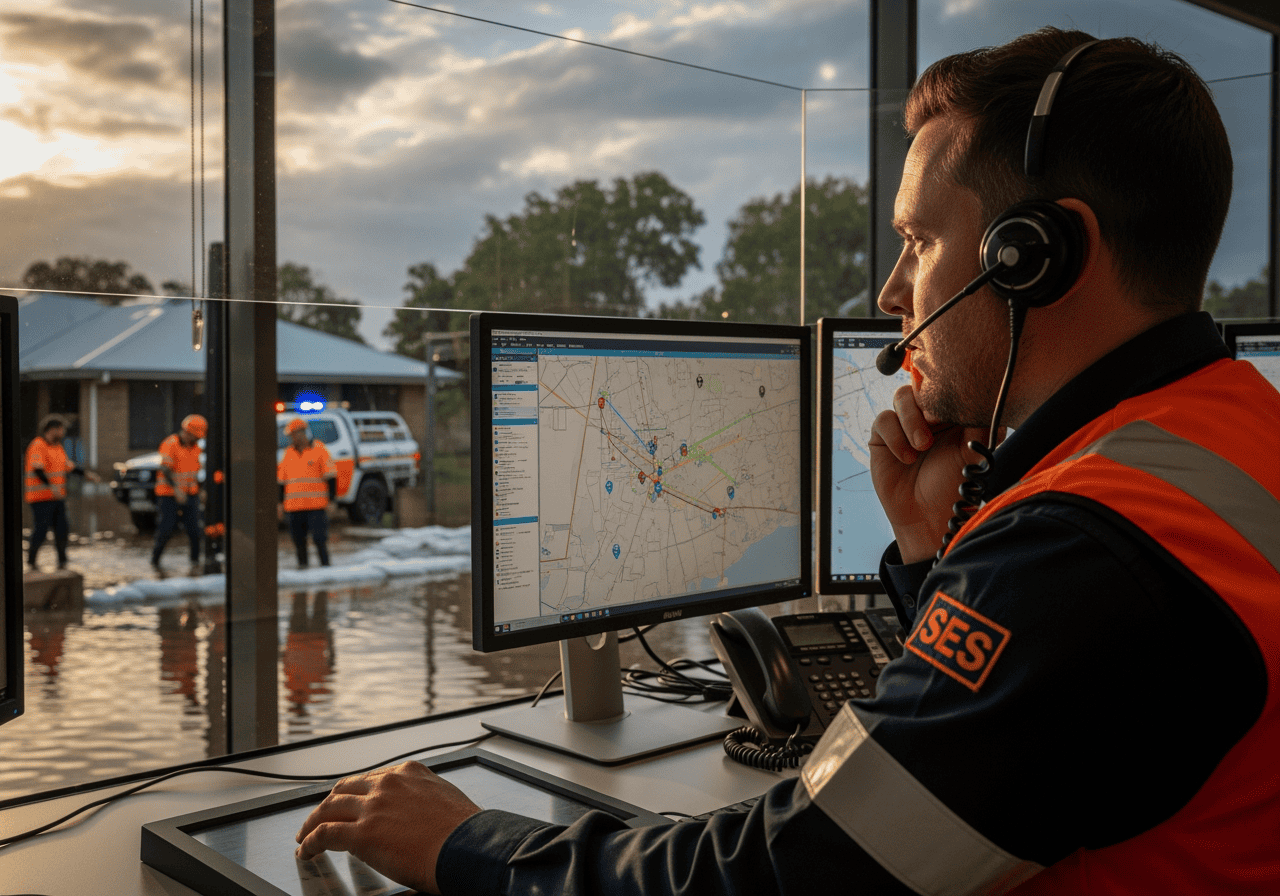
AiDial’s AI voice engine turns raw caller conversations into structured incident records in seconds, extracting critical data such as precise location descriptions, reported hazards, number of people affected and immediate risks. Those structured details are automatically formatted for dispatch and pushed to field crews through existing CAD and mobile dispatch apps, ensuring responders arrive with accurate situational context instead of relying on fragmented radio updates. The result is quicker, more confident decision-making at the frontline and reduced time-to-tasking for critical incidents.
Real-time two-way coordination is central to sustained response performance. Field crews can update incident status via short voice notes or simple app interactions that AiDial transcribes and attaches to the incident file, triggering automated ETA adjustments, resource reallocation or escalation alerts back at the call centre. This continuous feedback loop reduces radio congestion, avoids duplicated work, and keeps incident controllers and crews aligned on changing conditions, improving safety and operational efficiency during multi-agency responses or rapidly evolving weather events.
Every update, dispatch decision and voice exchange is recorded, timestamped and stored within Australia under AiDial’s Australian Data Sovereignty model, providing a secure, auditable trail for post-incident review, compliance and governance. Onshore processing reduces cross-border risk, supports state regulatory requirements and strengthens community trust that sensitive information remains local. Combined with local support and predictable data residency, AiDial helps state emergency services maintain resilient, cost-effective coordination that meets both operational and legal obligations.
Ensuring Data Security and Compliance with Australian Data Sovereignty
For state emergency services, where seconds count and sensitive personal information is routinely handled, keeping data on Australian soil is more than a preference it is a critical risk mitigation strategy. Australian Data Sovereignty ensures that call recordings, incident reports and location data remain subject to local laws, avoiding complications from foreign legal processes and reducing exposure to differing security standards. This is particularly important when collaborating across agencies, responding to multi-jurisdictional events or complying with subpoenas and freedom of information requests. By processing and storing all information domestically, AiDial enables clear chains of custody for evidence, predictable legal obligations for data access, and faster coordination with state privacy officers and auditors. The result is a more resilient emergency communications system that upholds citizens rights and maintains operational integrity during crises.
AiDial layers technical controls on top of local hosting to meet the stringent security expectations of emergency services. Data is encrypted both in transit and at rest, with role based access controls, multi factor authentication and comprehensive audit logs to monitor who accessed what and when. The platform is engineered to align with Australian regulatory frameworks including the Privacy Act and the Protective Security Policy Framework, supporting lawful handling of personal information and critical infrastructure protections. Because processing occurs domestically, incident response and forensic investigations are faster and free from jurisdictional friction. AiDial also supports regular security assessments and provides the reporting and evidence required for compliance audits, enabling procurement and risk teams to demonstrate governance without compromising service continuity during high demand periods.
Hosting and processing data in Australia delivers tangible operational benefits for emergency services beyond compliance. Local data sovereignty underpins community trust by assuring the public that highly sensitive information is governed by Australian law, which is vital when encouraging callers to share personal and medical details. It also means AiDial can provide local support teams that understand state and territory processes, deliver rapid onshore technical assistance during incidents, and implement changes without cross border delays. For interoperability, Australian hosting simplifies secure data sharing with health, police and municipal systems under memoranda of understanding, enabling real time exchange of structured incident details. These advantages translate into quicker response times, fewer administrative hurdles and a stronger public mandate for using AI voice automation in critical public safety workflows.
Enhancing Community Trust and Accessibility with Localised Voice Services
Localised voice services reduce the chance of misunderstanding during high-pressure emergency calls by recognising regional accents, place names and colloquial expressions common across Australian communities. AiDial models are trained on Australian speech patterns and local lexicon so callers from remote towns, multicultural suburbs or Indigenous communities are understood first time. That accuracy shortens call times, improves location capture and reduces the need for repeated clarifying questions, which directly speeds up triage and resource dispatch.
Accessibility improvements are also a practical outcome of localised voice design. AiDial can deliver clear, plain-language prompts, adjustable speech rates and support for multiple languages and dialects, including major community languages and culturally appropriate phrasing for Indigenous callers. These features make services easier to use for older Australians, people with limited English proficiency and those with low literacy, increasing call completion rates and reducing follow-up workload for call centres.
Enhancing trust goes hand in hand with accessibility when services are local and transparent. By combining localised voice interactions with AiDials Australian Data Sovereignty model, emergency services can assure communities that recordings and personal data remain in Australia, meeting privacy obligations and boosting public confidence. That local hosting, together with the ability to tailor voices and messaging to community expectations, helps build sustained engagement so people are more likely to call early, share accurate information and cooperate with responders—improving outcomes for both the public and emergency services.
Cost Savings and Operational Efficiency Through AI Voice Automation
AiDial provides intelligent call routing and automated triage that dramatically reduces average handling time and the need for large surge teams during incidents. By handling routine enquiries, capturing structured incident details and escalating only the highest priority calls to human operators, AiDial allows state emergency centres to flatten peak staffing spikes and reduce costly overtime. Predictive staffing tools use historical call patterns and real-time signals to optimise rosters, so agencies can schedule the right number of operators without over-hiring. Reduced call volumes and fewer manual tasks also shorten training cycles and improve retention, lowering recruitment and induction costs. Importantly, all voice processing and call data remain on Australian soil under AiDial Australian Data Sovereignty, which removes the added expense and complexity of cross-border data agreements and helps keep compliance overheads predictable and manageable.
Effective incident triage and precise situation capture minimise unnecessary dispatches and enable smarter allocation of crews and vehicles, directly reducing fuel, maintenance and wear costs. AiDial supplies field-ready incident summaries and status updates that integrate with dispatch and CAD systems, so responders arrive with clear context and agencies avoid repeated trips or duplicated responses. Better matching of resource type to incident severity reduces heavy vehicle usage for minor jobs and extends fleet life. The platform also supports post-incident analysis that identifies patterns of inefficient deployment, informing changes that deliver ongoing savings. Because all data is processed and stored in Australia under the Australian Data Sovereignty model, agencies can confidently share and analyse operational data without incurring the compliance risks or costs associated with international data transfers.
Moving to AiDial reduces infrastructure and vendor management costs by offering a single, Australian-hosted AI voice solution that removes the need for bespoke on-prem systems or complex overseas cloud contracts. Local hosting simplifies procurement, auditing and compliance with state and federal regulations, lowering legal and consultancy expenses tied to data residency and privacy. Ongoing management costs fall as AiDial provides updates, model tuning and local support without the premium of international vendors. Consolidated reporting and onshore data retention also make insurance and liability assessments more straightforward, which can reduce premiums. The combination of automated workflows, lower integration complexity and the assurance of Australian Data Sovereignty delivers predictable, sustained cost savings while preserving operational resilience and public trust.



Conclusion and Key Takeaways: Why AiDial’s Australian-Hosted AI Voice Matters for State Emergency Services
State Emergency Services that adopt AiDial AI voice solutions gain faster, more accurate call triage, automated situation assessment and incident capture, and the ability to scale call handling during peak weather events — all of which translate to quicker response times, reduced call queues and better allocation of crews on the ground. Real-time coordination between call centres and field teams, localised voice services that improve accessibility, and targeted automation also deliver clear cost savings and operational efficiencies while preserving high-quality community engagement during emergencies.
Crucially, AiDial keeps all voice processing and data storage on Australian soil, giving emergency services the security, compliance and public trust that come with Australian Data Sovereignty — a must for sensitive incident information and inter-agency sharing. The same locally hosted approach powers improvements across other sectors, from manufacturing in Welding and Fabrication: Boost Productivity with AI Calls to safety programs in Workplace Health and Safety Consulting for Australian Businesses and community-centred care in AI Solutions for Indigenous Health Services in Australia. To see how AiDial can strengthen your emergency communications while keeping data safely in Australia, Contact Us for a Consultation.