Mobile medical services are an essential strategy for improving access, reducing inequity and delivering genuinely patient centred care, particularly across regional and underserved communities, and to make these models work we must design care pathways that optimise outcomes while supporting clinicians with clear clinical governance and targeted workforce training. Practical mobile care models depend on technology enablers such as telehealth, remote monitoring and robust mobile connectivity to extend clinical reach and capture timely data, while AI voice solutions can streamline patient engagement and administrative workflows by automating appointment scheduling, intake, reminders and simple triage to reduce no-shows, free clinician time and lower operational costs. Ensuring patient trust and meeting regulatory obligations means data handling must be secure and local, which is why Australian Data Sovereignty is non-negotiable for health providers; keeping voice interactions and patient records processed and stored on Australian soil protects privacy, simplifies compliance and reassures patients and partners. Equally important are measurable KPIs that demonstrate cost savings and quality improvements — for example reduced wait times, higher patient satisfaction, quicker follow-up and lower per-patient administrative cost — so organisations can quantify value and refine services. Throughout this post we will examine how to build and govern mobile healthcare teams, choose and integrate the right technologies, leverage AI voice capabilities to improve efficiency and engagement, and apply clear metrics to ensure safe, secure and patient-centred mobile medical services that deliver both clinical benefit and sustainable business outcomes.
Why Mobile Medical Services Matter: Access, Equity and Patient Centred Care
Mobile medical services directly address the geographic and socioeconomic barriers that prevent many Australians from accessing timely care. For patients in rural, remote and outer-metropolitan suburbs, travel time, cost and workforce shortages create gaps in routine screening, chronic disease management and follow-up care. Mobile clinics and outreach teams reduce those barriers by delivering care closer to home and connecting patients with specialist advice without multiple long trips. Technology orchestration is essential for these models to scale: AI voice systems can automate appointment bookings, reminders and simple triage to reduce no-shows and optimise clinician schedules, lowering operational costs and improving capacity. Crucially, when those voice-driven interactions and patient records are processed and stored under Australian Data Sovereignty, community trust and regulatory compliance increase, giving local health services confidence that sensitive information remains onshore and governed by Australian privacy frameworks.
Patient centred care in mobile settings means more than clinical convenience; it requires cultural safety, personalised communication and respect for community governance. Mobile teams often work with Aboriginal and Torres Strait Islander communities, culturally and linguistically diverse groups and people experiencing disadvantage, so interactions must be adapted to local preferences, privacy expectations and consent models. AI voice solutions can personalise outreach messages, provide repeatable intake scripts and triage prompts that respect patient circumstances while freeing clinicians to focus on complex care. When these AI interactions are backed by Australian Data Sovereignty, local providers can demonstrate that community health information is stored and managed on Australian soil, addressing concerns about offshored data handling and supporting stronger relationships between mobile services and community stakeholders.
Mobile medical services reduce the logistical and financial burden on patients while strengthening continuity across the care pathway. By co‑ordinating home visits, community clinics and virtual follow-ups, mobile models minimise missed appointments and ensure timely monitoring for chronic conditions, vaccinations and post‑discharge care. Automated voice systems improve this continuity by handling pre‑visit intake, appointment confirmations and post‑visit follow‑ups, capturing timely administrative and symptom data that feeds back to clinicians. These efficiencies lower cost-per-patient and free clinician time for higher‑value clinical tasks, improving outcomes and patient satisfaction. Keeping all voice interactions and captured data within Australian borders under AiDial’s Australian Data Sovereignty framework further protects patient privacy, supports compliance with the Privacy Act and My Health Record expectations, and reassures patients and providers that their information is managed in line with Australian standards.
Designing Mobile Care Models to Optimise Patient Outcomes
Designing mobile care models starts with mapping the patient journey from referral through to follow up, identifying points where delays, miscommunication or data loss create risk to outcomes. Care pathways should include clear triage criteria, escalation protocols and a mix of face to face and virtual touchpoints so clinicians can deliver the right level of care at the right time. Practical details such as standardised intake forms, remote monitoring thresholds and timed reminder schedules reduce variation in care and make it easier to measure clinical impact. Automating administrative steps with AI voice solutions for appointment booking, pre-visit intake and reminders helps reduce no shows and frees clinicians to focus on complex care tasks. This automation must be designed to supplement clinical decision making, not replace it, with escalation triggers built into workflows when a voice interaction identifies clinical red flags. The ultimate aim is to create pathways that improve timeliness, continuity and patient experience while lowering operational cost.
Integration and interoperability are essential so mobile services are not isolated silos but part of a seamless health ecosystem, with data flowing between electronic medical records, telehealth platforms and remote monitoring systems. AI voice systems can capture structured information at the point of contact and synchronise it to clinical systems in real time, reducing transcription errors and improving the quality of captured data for audit and follow up. Crucially, keeping voice processing and data storage on Australian soil protects patient privacy and supports regulatory compliance, which reassures clinicians, partner organisations and patients that health information is secure. Australian Data Sovereignty also reduces latency and improves system reliability in regional deployments where international cloud routing can cause delays. When planners specify interoperability standards and onshore processing from the outset, mobile models scale more predictably and integrate more easily into existing clinical governance frameworks. That integration drives better risk management, clearer lines of clinical responsibility and faster decision cycles.
Designing for equity and scalability means co-designing services with local clinicians, community leaders and patients so mobile care respects cultural needs, language diversity and practical access barriers. AI voice solutions that support multiple languages and culturally tailored prompts can increase engagement and trust, while measured consent workflows and clear audit trails ensure transparency and accountability. Workforce planning should pair mobile clinicians with central coordination hubs that use real-time data to optimise scheduling, routing and resource allocation, reducing wasted travel time and increasing patient throughput. Onshore data handling via AiDial not only supports compliance but simplifies reporting for funding bodies and supports continuous quality improvement through local analytics. When mobile models are built with robust governance, culturally informed engagement and secure, locally processed voice automation, organisations can demonstrate reduced hospital admissions, faster follow up and measurable cost savings while delivering genuinely patient centred care.
Technology Enablers: Telehealth, Remote Monitoring and Mobile Connectivity
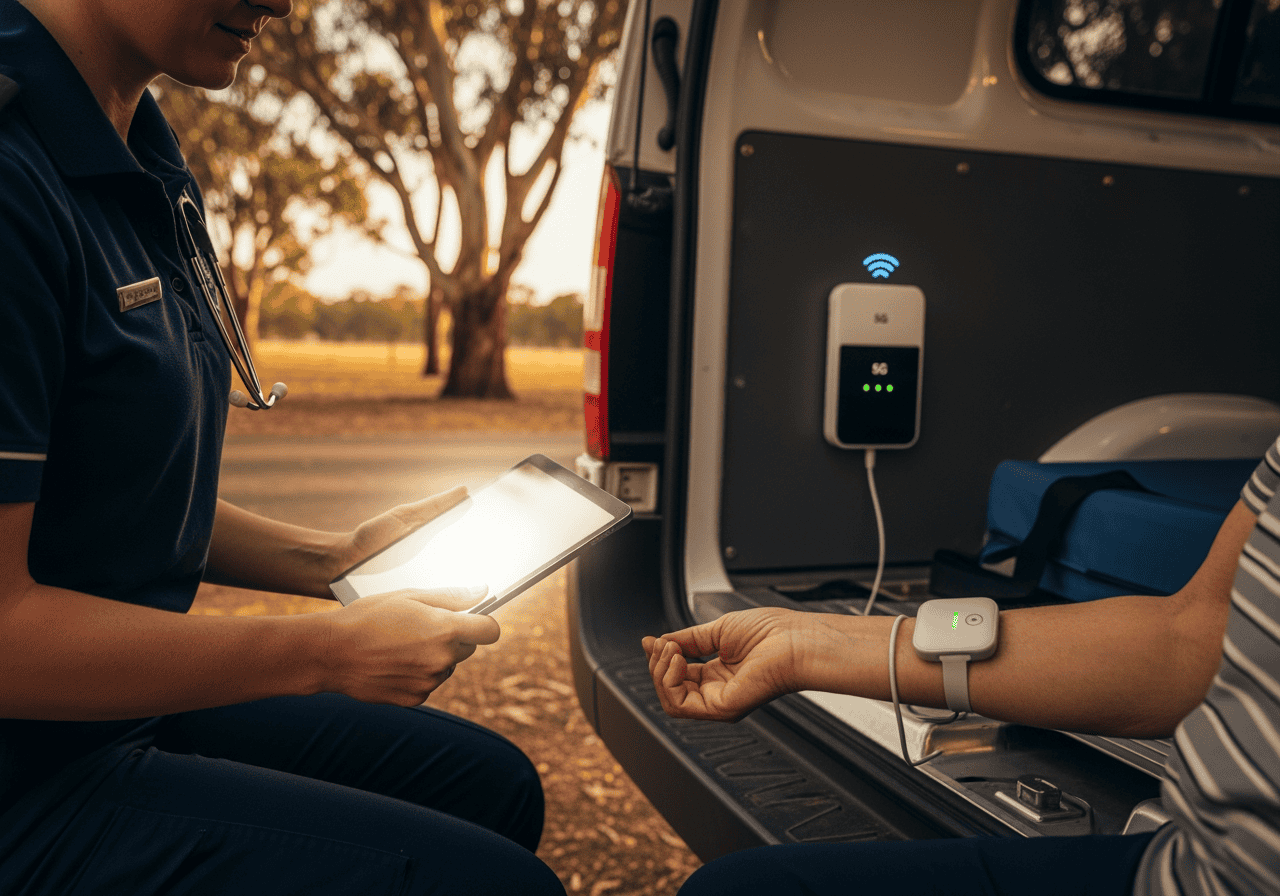
Telehealth is no longer a novelty but a core channel for delivering mobile medical services. Effective platforms must do more than enable video consults; they should integrate appointment scheduling, digital intake, clinical forms and electronic medical records to create a seamless patient journey from referral to follow up. AI voice solutions augment these workflows by automating reminders, completing intake calls, and conducting simple pre-triage to ensure clinicians see the right patients at the right time. For healthcare organisations this translates to fewer no-shows, cleaner clinical records and more time for direct care. Crucially, processing those voice interactions and storing associated data exclusively on Australian soil strengthens compliance with the Australian Privacy Principles and My Health Record expectations, and reassures patients and referrers that sensitive health information is governed by local law and oversight.
Remote monitoring extends clinical oversight into patients homes and community settings using wearables, implantables and connected devices. The challenge is turning continuous streams of data into actionable insights without overwhelming clinicians. Edge processing solves this by analysing signals locally on the device or gateway to detect trends, trigger alerts and compress or summarise data for transmission. AI voice systems can complement device data with conversational check-ins that capture symptoms, medication adherence and social determinants of health, enriching clinical context. When these audio and device-derived datasets are processed and stored within Australia organisations maintain stronger clinical governance, reduce cross-border risk and build patient trust. The outcome is earlier intervention, reduced avoidable admissions and more targeted use of in-person outreach resources.
Delivering reliable mobile medical services depends on resilient connectivity across metropolitan, regional and remote environments. Practical solutions use adaptive codecs, store-and-forward messaging, SMS and telephone fallbacks, and where needed satellite links to maintain continuity. Systems must also handle intermittent connectivity by caching encrypted data locally and synchronising once a stable link is available. Choosing infrastructure that processes and stores data in Australia reduces latency, simplifies compliance with procurement and privacy requirements, and limits exposure to foreign access laws. AiDials locally hosted AI voice platform is designed for this environment, offering fallbacks, onshore support and integration with existing clinical IT, so patient engagement and administrative automation remain uninterrupted. The commercial benefits include lower operational risk, predictable costs and improved patient experience across diverse connectivity conditions.
How AI Voice Solutions Improve Patient Engagement and Administrative Efficiency
AI voice solutions can automate routine patient interactions such as appointment scheduling, intake questionnaires, pre-visit triage and reminders, turning time-consuming phone loops into efficient, consistent processes. For mobile medical services this translates into fewer missed appointments and better utilisation of clinician time, which directly lowers operational costs and increases capacity to see more patients in regional and underserved areas. By capturing appointment confirmations and intake data in real time, these systems improve data accuracy and reduce administrative rework, helping mobile teams focus on clinical care rather than paperwork. AiDial’s platform is designed to integrate with existing practice management and electronic health record systems so information flows smoothly from voice interaction into clinical workflows.
Improved patient engagement is about making communication accessible, timely and personal, and voice is a natural medium for many patients who may have limited digital access or low literacy. AI voice interactions can be personalised by language, tone and local context, and escalated to a human clinician when complexity or risk is identified, ensuring safety and continuity of care. AiDial specifically trains its models to understand Australian accents and idioms and to comply with local clinical governance needs, which improves accuracy and patient trust. Because conversations can be handled 24/7, patients in remote communities can get answers and reassurance outside standard clinic hours without burdening scarce staff resources.
From an administrative perspective, AI voice automation streamlines billing prompts, referral follow-ups and post-visit care instructions, reducing manual processing and errors while creating auditable records for governance and quality measurement. These improvements contribute measurable KPIs such as lower no-show rates, reduced average handling time and lower cost per contact, which support the financial sustainability of mobile care programmes. Crucially, AiDial processes and stores data on Australian soil, ensuring compliance with Australian Privacy Principles and My Health Record obligations and reducing the risk of cross-border data exposure. That Australian data sovereignty combined with onshore technical support gives health providers and patients confidence that their sensitive information is secure and governed according to local laws and expectations.
Securing Patient Data: The Importance of Australian Data Sovereignty
Securing patient data in mobile medical services starts with meeting Australia’s regulatory framework. Health providers must comply with the Privacy Act 1988 and the Australian Privacy Principles, the Notifiable Data Breaches scheme and state-specific health records legislation, while aligning with clinical governance obligations. Australian Data Sovereignty reduces legal complexity by keeping processing and storage within domestic jurisdiction, which simplifies compliance reporting and reduces the risks associated with cross-border data transfers. For mobile clinics that collect sensitive health information via telehealth, intake forms and remote monitoring, partnering with a provider like AiDial that processes voice data exclusively on Australian soil helps ensure that clinical teams meet their statutory duties and privacy obligations. This lowers exposure to foreign legal orders, supports clearer consent arrangements with patients and streamlines audits and regulatory enquiries, allowing clinicians to focus on care rather than complex international data governance issues.
Effective data security for mobile medical services combines strong technical controls with local infrastructure. Hosting AI voice processing and storage in Australian data centres enables low-latency performance for remote communities and keeps encryption keys, access logs and backups under domestic custody. AiDial’s approach uses end-to-end encryption, role-based access controls, robust authentication and regular security testing within Australian facilities, which reduces the attack surface associated with international cloud routes. Local processing also speeds incident response and forensic investigation, since support teams, auditors and incident handlers operate under the same legal framework and time zones. For organisations seeking ISO 27001 or other certifications, Australian-resident infrastructure simplifies evidence collection for compliance and penetration testing. The result is a tangible reduction in operational risk, improved uptime for mobile services and assurance that patient voice data remains protected to Australian standards.
Trust is crucial for patient uptake of mobile services, especially in regional and underserved communities where concerns about privacy can limit engagement. Demonstrating that patient interactions are processed and stored exclusively within Australia strengthens community confidence and supports culturally safe practices, including clear consent and local data stewardship. Australian Data Sovereignty also underpins operational resilience: keeping backups and disaster recovery resources onshore ensures continuity when international links are disrupted and enables faster restoration of services after incidents. For healthcare leaders, choosing AiDial’s locally hosted AI voice solutions delivers measurable outcomes—higher patient engagement, fewer consent barriers, and lower legal and operational risk. That combination promotes sustainable, scalable mobile models that respect patient expectations and regulatory requirements while improving efficiency and protecting the most sensitive health information.
Workforce, Training and Clinical Governance for Mobile Healthcare Teams
Delivering mobile medical services demands a workforce model that balances clinical expertise, logistical capability and cultural competence. Define clear roles for nurse practitioners, GPs, allied health and support staff, and invest in targeted training that reflects the realities of on‑site assessments, remote supervision and rapid decision making. Practical training methods include scenario based simulation, supervised field shifts and competency checklists that focus on safe assessment, infection control and documentation. Automating routine administrative tasks with AiDial AI voice solutions such as appointment scheduling, pre‑visit intake and reminders reduces clinicians administrative load, increases time available for direct patient care and helps lower workforce burnout and turnover while improving clinic throughput and cost efficiency.
Robust clinical governance is essential to ensure consistent, safe care across dispersed teams. Establish standardised care pathways, escalation protocols, clinical oversight arrangements and clear lines of accountability, and integrate these into digital workflows so that every mobile encounter is auditable and measurable. AiDial supports governance by standardising spoken intake, triage prompts and consent capture while recording structured data that feeds into electronic medical records and quality frameworks. Crucially, because AiDial processes and stores voice and patient data exclusively in Australia, organisations can meet Privacy Act obligations and My Health Record requirements, simplify auditor and insurer assessments and build patient trust through demonstrable Australian data sovereignty.
Ongoing workforce development should combine technical training with continuous feedback loops and accessible local support. Use recorded and de‑identified call examples for coaching, track competency KPIs and offer micro‑learning modules for device use, documentation standards and telehealth etiquette. Technology acceptance is improved when teams receive hands‑on training and prompt local support; AiDial provides implementation assistance and training that align with Australian clinical governance expectations and data residency policies, shortening approval timelines and reducing risk. The result is a more resilient mobile workforce that delivers higher quality care, captures timely clinical data and achieves measurable operational savings for health services operating in regional and underserved communities.
Measuring Success: KPIs, Cost Savings and Quality Improvements
Define a focused set of KPIs that link patient access and clinical outcomes to operational performance. Core measures should include appointment fill rates, no-show rates, time from referral to first contact, average consultation duration, rate of successful remote assessments and clinical escalation frequency. Track telehealth uptake and remote monitoring adherence to understand reach across regional and underserved communities. Use real-time dashboards that combine clinical and administrative data so teams can spot bottlenecks and redistribute resources. AiDial’s AI voice solutions play a direct role by automating scheduling, intake and reminder workflows, which improves appointment fill and reduces no-shows while capturing structured data for reporting. Because AiDial operates with Australian Data Sovereignty, all voice interactions and derived analytics remain processed and stored on Australian soil, supporting regulatory compliance, auditability and the patient trust essential for measuring and improving KPIs in healthcare settings.
Translate improvements into dollar terms to build the business case for mobile care. Key cost metrics include cost per patient contact, administrative labour hours per appointment, travel and outreach costs saved, and reduction in avoidable emergency department presentations. Model scenarios comparing traditional outreach workflows to mobile care augmented with automation to show reductions in clinician time spent on non-clinical tasks. AiDial reduces repetitive administrative overhead by handling appointment booking, reminders and simple triage, which lowers cost per contact and reduces dependency on temporary staffing. When calculating savings, include indirect benefits such as improved clinician retention from reduced administrative burden and increased capacity to deliver high-value care. Highlight that Australian Data Sovereignty reduces legal and compliance risk costs tied to cross-border data transfers, and simplifies procurement for state and federal health providers who require data to be held within Australia.
Quality metrics must assess both clinical safety and patient-centred experience. Track patient-reported outcome measures, symptom resolution rates, follow-up compliance, medication adherence and adverse event incidence. Combine quantitative scores with qualitative feedback gathered after mobile visits and telehealth encounters to capture cultural safety and accessibility concerns important in regional practice. AiDial’s conversational AI can collect PROMs and satisfaction data immediately after contact, flagging patients who need follow-up and closing the feedback loop without adding clinician workload. Storing these voice-derived insights under the protection of Australian Data Sovereignty reassures patients their sensitive information is secured locally and supports transparent quality audits. Use these insights to set improvement targets, run Plan Do Study Act cycles and share outcomes with funders and commissioners to demonstrate continuous quality improvement.



Conclusion and Key Takeaways for Implementing Secure, Patient-Centred Mobile Medical Services
Mobile medical services offer a practical route to better access, equity and patient-centred care when models are designed around real-world workflows, workforce capability and measurable outcomes. Prioritise simple, co-designed care pathways that use telehealth, remote monitoring and mobile connectivity to reduce avoidable visits, speed treatment and improve follow-up. Invest in workforce training and clinical governance so mobile teams can deliver consistent, safe care, and track success with clear KPIs that capture clinical quality, patient experience and cost savings. For practical thinking about in-home and support staffing models, see our guide on au pair programs which can offer transferable insights for community care resourcing.
Technology should enable people, not replace them: AI voice solutions can automate routine administrative tasks, improve patient engagement and capture leads while freeing clinicians to focus on care. Crucially, choose platforms that keep patient information on Australian soil — Australian Data Sovereignty reduces regulatory risk, strengthens security and builds patient trust. Organisations that combine secure, locally hosted AI voice systems with robust clinical governance will see faster workflows, lower operating costs and higher patient satisfaction; lessons from other mobile-heavy sectors such as building and construction site communications show the same benefits in connectivity and safety. Book a Demo or contact us for a consultation to explore how AiDial’s Australian-hosted AI voice solutions can secure and optimise your mobile medical services.