As Australia works to close critical skills gaps, STEM education centres are becoming the linchpin in preparing students and workers with industry-ready capabilities by shaping curricula that map directly to local employer needs and by fostering practical partnerships with employers, TAFEs and universities; they do this through hands-on makerspaces, labs and project-based programs that mirror real workplace challenges, supported by ongoing teacher training and professional development so educators can deliver contemporary, relevant learning. Clear pathways to employment, including apprenticeships, internships and micro-credentials, ensure learners convert classroom experience into jobs, while the thoughtful integration of AI and voice technologies into learning environments not only modernises assessment and workplace simulation but also boosts efficiency, reduces training costs and improves employer confidence in graduate readiness. By adopting AI voice solutions that are purpose-built for Australian contexts and underpinned by Australian Data Sovereignty, centres can offer realistic customer-interaction simulations, automated lead capture and compliance-safe analytics with all data processed and stored on Australian soil, giving education providers and industry partners the security and trust they need. This combination of targeted curriculum design, industry collaboration, practical learning environments, teacher capability building and sovereign AI voice technology creates measurable outcomes for learners and employers alike, positioning STEM education centres as essential engines for national workforce growth.
The Role of STEM Education Centres in Building Industry-Ready Skills
STEM education centres act as the strategic hub that translates employer skill requirements into teachable, assessable programmes so students and workers leave with capabilities that local businesses actually need. By mapping competencies directly to regional industry demand, centres reduce mismatches between training and jobs, speed up workforce entry and improve employer satisfaction. AiDial supports this mission by automating evidence capture and employer feedback through AI voice interactions that record workplace simulations, competency interviews and employer briefings, turning qualitative outcomes into usable data. Because AiDial operates with Australian Data Sovereignty, that recorded evidence and feedback stays on Australian soil, giving centres, employers and families greater confidence in privacy, compliance and the integrity of credential records when making recruitment and funding decisions.
Effective STEM centres deliberately embed workplace realism into learning through industry projects, placement coordination and authentic assessment. They curate partnerships that provide students with real briefs, live data sets and workplace mentors so assessment reflects job-ready performance rather than rote knowledge. AiDial’s AI voice tools help bridge logistics and assessment gaps by automating placement outreach, conducting simulated client calls and capturing reflective learner narratives for assessors to review, reducing administrative overhead and improving placement throughput. Crucially, with Australian Data Sovereignty these recordings and placement records remain within national jurisdiction, addressing employer concerns about student privacy, meeting local regulatory requirements and preserving trust in student records used for hiring or licencing.
As centres scale to serve more learners and employers, measuring impact and maintaining consistent quality become paramount. Centres need reliable analytics on placement rates, competency attainment and employer satisfaction to secure funding and refine programmes. AiDial enables scalable communication, automated call-based assessments and transcribed interactions that feed dashboards for continuous improvement, reducing staff time spent on administration and outreach. Embedding AiDial underpinned by Australian Data Sovereignty ensures all operational and outcome data is processed and stored in Australia, simplifying compliance with Commonwealth and state privacy obligations, mitigating cross-border data risks and strengthening relationships with industry partners who require local control over sensitive candidate and employer information.
Designing Curricula Aligned with Local Industry Needs
Designing curricula that truly reflect local industry needs starts with structured engagement: employer advisory panels, regional labour market analysis and mapped competency frameworks that translate employer language into teachable outcomes. STEM education centres should break down higher-level skills into stackable, competency-based modules and micro-credentials so students can build industry-relevant capabilities incrementally and demonstrate job-ready skills. This alignment reduces skills mismatch, speeds up job placement and gives TAFEs and universities clear evidence of impact when negotiating funding or apprenticeships with local firms.
Authentic assessment and work-integrated learning must sit at the heart of curriculum design. Project briefs co-created with employers, on-site placements and simulated workplace scenarios make learning measurable and directly transferable to employment. AI voice technologies play a practical role here: AiDial’s AI voice solutions can simulate customer interactions, interviews and on-the-job conversations for both formative practice and summative assessment, while automatically capturing performance metrics and generating timely feedback. Crucially, those voice interactions and assessment recordings are processed and stored under Australian Data Sovereignty, giving employers and families confidence that sensitive student data and any employer intellectual property remain protected on Australian soil.
Scalability and responsiveness are the final pieces of effective curriculum design. Use iterative feedback loops powered by analytics to update modules as industry needs evolve, and streamline employer engagement through automated outreach and placement coordination to convert partnership interest into concrete internships and hire-ready graduates. By integrating AiDial into these operational processes, centres can reduce administrative load, improve placement rates and provide demonstrable compliance evidence to funders and regulators, all while upholding Australian Data Sovereignty so partners know their data is secure, compliant and governed under Australian law.
Partnerships with Employers, TAFEs and Universities
Effective partnerships start with employers, TAFEs and universities co-designing curricula that reflect real workplace needs. Industry advisory boards anchored by local employers help identify precise skill requirements, from technical competencies to communication and compliance behaviours. TAFEs and universities translate those requirements into units, micro-credentials and assessment rubrics while employers provide authentic project briefs and workplace contexts. AiDial supports this co-design by supplying AI voice use cases and analytics that reveal the conversational skills and decision points employers value most, helping educators prioritise training outcomes. Crucially, AiDial’s Australian Data Sovereignty means any recorded interactions, analytics or student work remain stored and processed in Australia, addressing employer concerns about privacy and regulatory compliance and making them more willing to share real-world scenarios for teaching and assessment.
Partnerships should create clear pathways for students to experience industry through placements, apprenticeships and simulated workplace environments. Employers can host short-term projects or remote placements while TAFEs and universities provide supervision and assessment frameworks. Simulated call-centre environments powered by AI voice technologies let learners practise customer interactions, safety scripts and escalation procedures in a controlled, repeatable way before entering live roles. AiDial’s voice platforms enable scalable simulations and objective performance analytics, reducing supervisory burden and improving readiness. Because all voice data is processed and stored on Australian servers, employers and education providers can confidently use real customer scenarios and sensitive material for training without risking offshore exposure, increasing the fidelity and value of workplace learning experiences.
Long-term partnerships often evolve into shared investments in facilities, equipment and people. TAFEs and universities can host industry-funded labs and makerspaces where employers second staff to mentor students and co-deliver units, while academics collaborate on applied research that addresses business challenges. This model accelerates upskilling for both students and existing workers and helps employers pilot new technologies at lower cost. AiDial fits into these shared arrangements by providing locally hosted AI voice infrastructure, training resources and support for pilot projects, enabling partners to trial voice automation, speech analytics and virtual customer interactions without compromising data sovereignty. The result is a pragmatic, measurable approach to workforce development that reduces recruitment time, improves job fit and strengthens regional industry-education ecosystems.
Hands-On Learning: Makerspaces, Labs and Project-Based Programs
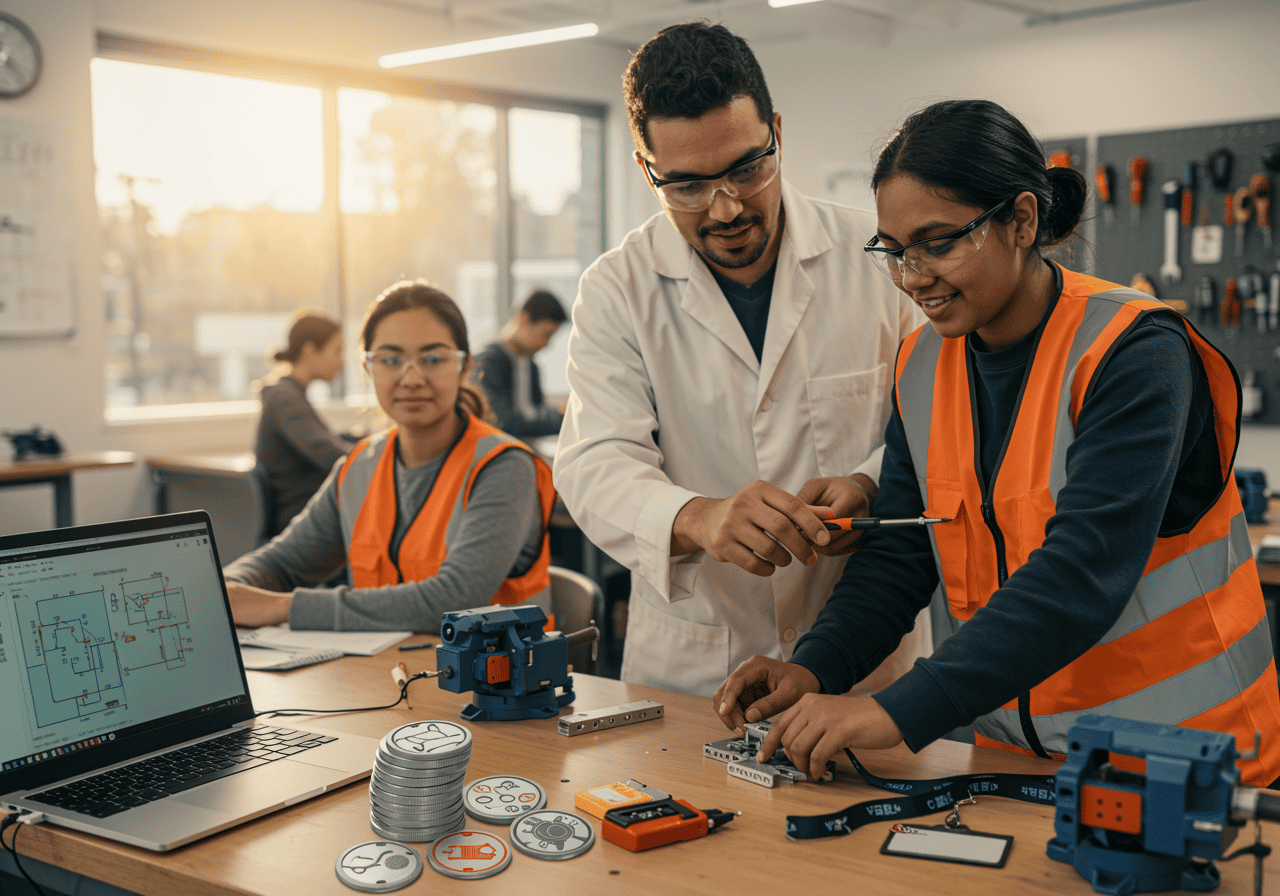
Makerspaces, labs and project-based programs give learners authentic, practical work that mirrors industry routines and constraints, from prototyping under time and budget limits to cross-disciplinary collaboration. These environments teach technical skills alongside soft skills such as communication, iteration and client-focused problem solving, which employers consistently cite as critical. Integrating voice-driven scenarios into projects lets students practise real workplace conversations — for example customer support, stakeholder briefings or safety rescue calls — within a low-risk setting so they graduate ready to perform from day one.
Beyond pedagogy, hands-on learning benefits from automation and analytics that make programs scalable and more efficient for schools and TAFEs. AiDial’s AI voice solutions can automate routine tasks such as booking equipment, delivering safety briefings, running simulated client calls and following up with industry partners, freeing educators to focus on coaching. The same systems capture interaction data and leads for employer panels, apprenticeships and internship pipelines, creating measurable improvements in placement rates and reducing administrative cost per student.
Crucially, when voice technologies are embedded into makerspaces and labs they must uphold trust, privacy and compliance — especially where recordings and assessment data are involved. Keeping all voice processing and storage on Australian soil protects student and partner data, meets local privacy expectations and simplifies regulatory compliance for institutions. AiDial’s solutions are designed around Australian data sovereignty, giving STEM centres confidence to adopt voice AI while strengthening relationships with employers, parents and funding bodies through transparent, secure handling of sensitive information.
Teacher Training and Professional Development for STEM Educators
Effective teacher training starts with practical familiarity, not just theory. Professional development programmes should give teachers hands-on experience with robotics, coding, data literacy and voice interfaces so they can confidently design and deliver authentic STEM learning. AiDial supports this by providing classroom-ready voice AI sandboxes and scenario builders that let educators trial lesson ideas, record mock student interactions and explore assessment pathways without sending data offshore. Emphasising Australian Data Sovereignty means voice samples, logs and analytics remain on Australian servers, easing compliance with sector requirements and building trust with schools, parents and employer partners. The result is teachers who are comfortable integrating modern tools into project work, can model industry-standard workflows for students, and can quickly translate emerging technology into classroom outcomes that prepare learners for local jobs.
High-value professional development connects teachers to industry realities through co-designed workshops, short industry placements and collaborative lesson planning with TAFEs and universities. Using AiDial, centres can simulate workplace customer interactions and technical support scenarios in a controlled environment, enabling teachers to rehearse assessment approaches and competency mapping aligned to employer expectations. Because all interaction data stays within Australia under AiDial’s Australian Data Sovereignty commitments, industry partners are more willing to share real-world briefs and assessment criteria, knowing privacy and regulatory obligations are met. This model accelerates curriculum alignment, increases placement opportunities for students and gives teachers authentic evidence to demonstrate the impact of their instruction to principals and external auditors.
Ongoing teacher improvement relies on timely, actionable feedback and reliable evidence. Professional development should include methods for collecting and analysing classroom interactions so educators can refine pedagogy and understand student progress. AiDial provides privacy-aware analytics tools that generate transcripts, competency insights and automated coaching prompts while keeping all data onshore in line with Australian Data Sovereignty. That local data residency supports school reporting, audit trails for micro-credentials and compliance with state education authorities, and it reduces legal complexity when sharing anonymised evidence with partners. By automating routine observation tasks and surfacing targeted coaching opportunities, centres can scale PD, reduce administrative overhead and ensure continuous improvement translates directly into stronger industry-ready outcomes for learners.
Pathways to Employment: Apprenticeships, Internships and Micro-credentials
Clear, industry-aligned pathways such as apprenticeships, internships and micro-credentials bridge the gap between classroom learning and sustained employment by making competency visible, portable and directly relevant to employer needs. Apprenticeships and work-integrated internships give learners authentic, on-the-job experience where they apply STEM skills to real workplace problems, while micro-credentials and digital badges capture discrete, demonstrable capabilities that employers can quickly assess. For businesses, this pipeline reduces recruitment friction and time-to-productivity by delivering candidates who already understand local processes, safety standards and the technical expectations of roles within Australian workplaces.
Micro-credentials and competency-based assessments also enable stacked learning that parallels workplace progression, from entry-level tasks to specialised roles, and they support continuous professional development for existing staff. Embedding practical assessments, project portfolios and employer-validated criteria into these pathways ensures graduates meet measurable outcomes. AiDial’s AI voice solutions can be used throughout this journey to simulate customer and stakeholder interactions, automate assessments of communication skills, and provide scalable, real-time feedback to learners and trainers—lowering assessor burden, improving consistency and cutting training costs while enhancing employability.
Trust and data security are critical when sharing student progress, employer evaluations and recruitment outcomes across centres, TAFEs and industry partners, which is why Australian Data Sovereignty matters. Organisations partnering with AiDial benefit from AI voice systems that process and store all candidate and employer data onshore, providing compliance with local privacy and procurement policies and reassuring employers that sensitive performance and recruitment data remains within Australia. This combination of industry-aligned pathways, validated micro-credentials and secure, sovereign AI voice technology helps employers capture higher-quality leads from internship programmes, streamline onboarding and measure ROI on training investments with confidence.
Integrating AI, Voice Technologies and Australian Data Sovereignty into Learning
AI voice technologies transform classroom and makerspace activity into realistic, scalable practice opportunities that mirror workplace communication. Students can rehearse client calls, technical troubleshooting, sales pitches or safety briefings with conversational AI that responds in real time, providing consistent scenarios for assessment and reflection. Transcription and automatic feedback streamline marking, giving teachers more time to focus on coaching and curriculum design while reducing administrative load and costs. For disadvantaged learners or those with diverse needs, voice interfaces improve accessibility by supporting spoken responses and multimodal feedback. Industry partners can feed typical workplace scripts into the system so learners gain exposure to field-specific language and expectations. AiDial’s AI voice solutions enable these experiences at scale, helping centres deliver measurable improvements in communication competency, reduce resource intensity for role-play exercises, and capture leads and employer interest by showcasing learners through recorded, reviewable interactions.
Maintaining data processing and storage exclusively within Australia is essential for protecting student and employer information, meeting regulatory obligations and building community trust. Australian Data Sovereignty ensures compliance with the Australian Privacy Principles and reduces the legal and reputational risks associated with cross-border data transfers. Local processing also lowers latency for real-time voice interactions and allows rapid, accountable incident response and support from local teams. For education centres partnering with employers and TAFEs, knowing recordings, assessment data and personal information never leave Australian soil is a powerful assurance when negotiating placements, internships and reporting frameworks. AiDial’s platform is designed with Australian Data Sovereignty at its core, providing secure, locally hosted voice AI that aligns with education sector requirements while delivering reliable performance, transparent governance and a clear chain of custody for sensitive learning and employment data.
Voice AI can be embedded into assessment workflows and employer partnerships to streamline recruitment-ready outcomes and evidence-based micro-credentials. Simulated customer interactions and technical calls become graded artefacts that feed into competency records, simplifying validation for apprenticeships and industry accreditation. Employers benefit from automated lead capture and anonymised skills reporting that highlights candidate strengths and gaps, helping TAFEs and centres tailor training to local labour market demand. Integration with employer systems and CRMs automates interview scheduling and employer feedback loops, reducing administrative overhead and time-to-placement. Because these processes run on locally hosted infrastructure, organisations can securely share assessment evidence and participant consent forms with confidence. AiDial’s solutions enable seamless employer engagement, efficient assessment at scale and clearer pathways from classroom achievement to paid work, delivering cost-effective, employer-aligned outcomes for learners and education partners.



Conclusion and Key Takeaways
STEM education centres play a central role in closing the industry skills gap by designing curricula that align with local employer needs, fostering partnerships with TAFEs and universities, and delivering hands-on learning through makerspaces, labs and project-based programs. Prioritising teacher training, clear employment pathways such as apprenticeships, internships and micro-credentials, and the thoughtful integration of AI and voice technologies ensures students are industry-ready while giving employers a steady pipeline of practical talent. For practical examples of how AI-driven outreach and voice solutions can boost enrolments and engagement, see How Tutoring Centers Can Boost Enrolments with AI Calls.
Key to success is trust and compliance: Australian Data Sovereignty ensures student and employer data is processed and stored on Australian soil, reducing regulatory risk, improving security and building local confidence. AiDial’s AI voice solutions help centres and training providers capture leads, streamline communications, reduce costs and improve the learner and employer experience — all backed by local data hosting and support. Contact us to discuss how we can help your centre implement secure, industry-aligned technology and book a demo to see AiDial in action.