Australian schools supporting students with additional needs face a complex mix of communication barriers, diverse learning profiles and stretched resources, and AiDial’s AI voice solutions are designed to address these challenges by improving accessibility, personalising learning and freeing staff to focus on teaching; by converting speech to clear text and delivering natural text-to-speech prompts, AI voice assistants help students engage more consistently, adapt content and pacing to individual needs, and provide real-time support in the classroom while automating routine tasks such as attendance, behaviour logs and Individual Education Plan notes to reduce administrative burden for teachers and support staff. Because school leaders must balance student safety, parental trust and regulatory obligations, keeping voice data processed and stored exclusively on Australian soil is central to maintaining privacy, compliance and community confidence, and working with a locally-based provider like AiDial ensures those safeguards are built in. Seamless integration with existing school systems and workflows means minimal disruption to learning management systems and student information systems, and built-in analytics let schools measure engagement, attendance and resource efficiency so they can demonstrate tangible improvements and cost savings. Practical next steps include piloting targeted use cases, involving educators and parents in design, training staff on workflows and tracking outcome metrics to scale what works, with AiDial providing the secure, sovereign AI voice platform and local support to implement and optimise solutions for better student outcomes.
Understanding special needs education challenges in Australian schools
Students with additional needs present a wide range of communication and sensory profiles that challenge standard classroom routines. Some students have speech or language disorders, others process auditory information more slowly, and many rely on augmentative and alternative communication tools. Mainstream teachers must juggle clear verbal instruction, visual supports and personalised pacing while maintaining whole-class engagement. Inconsistent delivery of prompts and feedback, or noisy environments, can erode comprehension and confidence. Schools also work with culturally and linguistically diverse families, which adds complexity to communication with parents and carers. These practical barriers make it difficult to ensure every student receives timely, accessible information in the format they need. That gap underscores the potential for AI voice assistants to provide consistent speech-to-text conversion and natural text-to-speech prompts in class. Solutions that are designed for education can help bridge communication gaps while aligning with school policies and expectations for student support.
Australian schools are operating with constrained staffing budgets, rising caseloads for special education staff and increasing administrative expectations. Teachers and support staff spend significant time documenting Individual Education Plans, recording behaviour incidents, coordinating specialist visits and communicating progress to families. This paperwork and data entry reduces time for direct instruction, personalised interventions and relationship-building with students. Access to allied health professionals such as speech pathologists or occupational therapists is often limited, leading schools to seek scalable ways to maintain consistent support. The result is uneven implementation of strategies and lost opportunities to intervene early. Automation and intelligent voice tools can capture notes, streamline attendance and behaviour logs, and generate initial drafts of IEP entries to free educators for high-value tasks. When implemented thoughtfully, such tools can enhance workforce capacity without replacing the professional judgement of teachers and therapists.
Trust is central to special needs education. Parents and carers expect schools to protect sensitive health and behavioural information, comply with the Australian Privacy Principles and safeguard children from unauthorised access. Use of cloud services hosted offshore or by large global providers raises questions about cross-border data flows, jurisdictional access and the potential for inadvertent exposure of student records. These concerns are amplified in sectors working with minors and with complex funding frameworks such as NDIS plans. Schools need assurance that technology partners will handle data responsibly, respond quickly to incidents and align with state and federal regulatory obligations. Australian Data Sovereignty matters because local processing and storage reduce legal ambiguity, shorten incident response times and build parental confidence. AiDial’s approach of keeping data on Australian soil and providing local support addresses these governance and trust challenges while enabling schools to adopt AI voice capabilities safely.
How AI voice solutions enhance communication and accessibility
AiDial voice technology brings classroom speech into accessible formats by turning live teacher and peer conversations into accurate, real time transcripts and providing natural, adjustable text to speech for instructions and learning materials. This capability supports students with hearing impairment, auditory processing difficulties and EAL/D learners by making spoken content visible and repeatable at a chosen pace and reading level. For teachers, automated captioning and searchable transcripts reduce the need for ad hoc notes and ensure instructions are consistent, enabling clearer communication during group work, special education sessions and parent meetings.
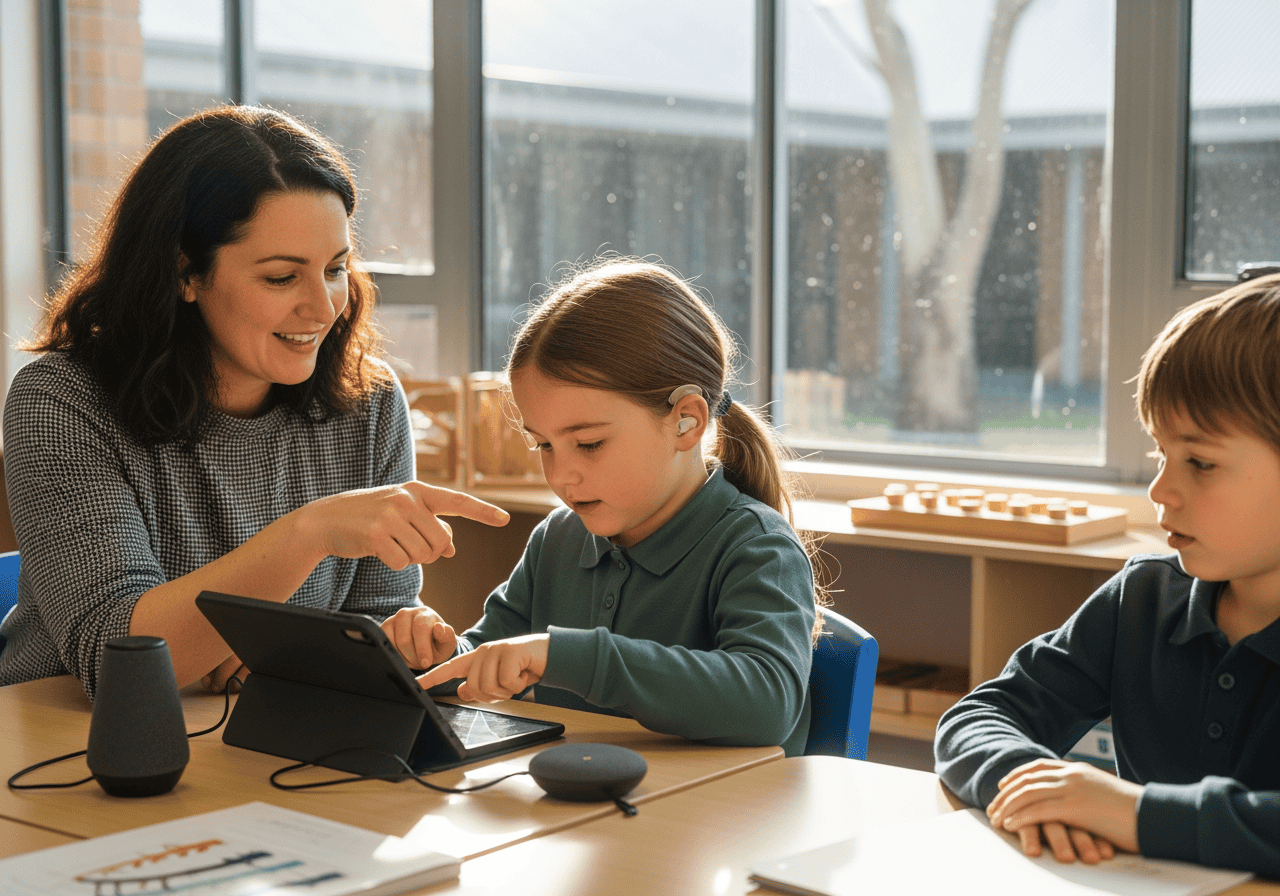
Beyond transcription and narration, AI voice assistants act as personalised aides that deliver step by step prompts, visual and auditory cues, timers and social stories to support independence and reduce anxiety for students with diverse learning needs. Voices, tempo and language complexity can be customised to match individual learning plans, and the assistants can be accessed through tablets, classroom devices or switch based controls to accommodate motor impairments. These features make the technology an inclusive tool that can replace intrusive human prompting, maintain dignity for students and free staff to focus on higher value teaching and therapeutic interventions.
Crucially, these accessibility gains are delivered in a framework that prioritises Australian Data Sovereignty, so student voice data is processed and stored on Australian soil to meet state and federal privacy expectations and build parental trust. Local processing also reduces latency for real time captioning and prompts, creating a seamless in class experience, and allows schools to work with a provider that understands Australian education compliance and support needs. The result is improved engagement and comprehension for students, stronger communication between school and home, and measurable reductions in time spent managing accessibility tasks for staff.
Personalised learning and adaptive support with AI voice assistants
AI voice assistants can transform one-size-fits-all lessons into dynamically tailored learning experiences that respond to each student in real time. Using speech-to-text and natural text-to-speech, AiDial’s solution can present content at adjustable reading levels, rephrase instructions, and slow or accelerate delivery to match a student’s processing speed. Teachers can set preferences for vocabulary, sentence length and multisensory prompts so that literacy, numeracy and classroom routines are personalised without extra planning time. Because AiDial processes and stores voice interactions on Australian soil, schools can enable deep customisation with confidence that sensitive learning profiles and recorded exchanges remain within domestic data controls, supporting parental trust and sector compliance. The result is more consistent engagement, fewer one-on-one interruptions and measurable improvements in on-task behaviour as students receive the right support at the right moment while staff maintain oversight through simple teacher controls.
For students with speech, language or motor challenges, AI voice assistants act as unobtrusive communication partners that promote independence. AiDial’s adaptive speech models can convert student vocalisations or typed notes into clear, natural-sounding prompts and responses, or provide augmentative and alternative communication (AAC) options that reflect individual voice and expression preferences. This reduces the stigma of assisted communication and encourages peer interaction by normalising participation. Multilingual support and customised speech profiles help culturally and linguistically diverse learners engage in their preferred language, while consistent, automated prompts scaffold routine tasks such as transitions, instructions and self-regulation strategies. With all processing anchored in Australia, schools can confidently share AAC profiles and communication logs with allied health professionals and families, ensuring continuity of support without exposing data to offshore systems.
AI voice systems provide ongoing, low-friction assessment that feeds adaptive learning pathways. Short, spoken comprehension checks and practice interactions create a continuous stream of formative data that AiDial analyses to identify progress, gaps and emerging needs. That intelligence can automatically adjust task difficulty, recommend scaffolds or generate suggested IEP notes for teacher review, saving time and giving educators actionable insights. Schools gain better allocation of specialist time because students who need intensive intervention are flagged earlier, while others can consolidate skills independently. Crucially, by keeping assessment audio, transcripts and analytics within Australian jurisdiction, AiDial ensures that sensitive performance data is governed by local privacy standards and can be securely integrated with school management systems, protecting student confidentiality while enabling data-driven decisions that improve outcomes and resource efficiency.
Reducing administrative burden for teachers and support staff
Teachers and support staff in special needs settings often spend hours each week on routine administrative tasks that take them away from direct student support. AI voice assistants can capture attendance, behaviour incidents and Individual Education Plan notes in real time through simple voice commands or classroom recordings, turning spoken observations into accurate, searchable text. This reduces manual data entry and duplication across systems, so records are completed promptly and consistently without interrupting lesson flow or therapeutic activities.
Beyond transcription, AI-driven workflows automate repetitive processes such as generating standardised progress summaries, populating report templates and issuing parent notifications or follow-up reminders. Integration with existing student information systems means entries made by voice are automatically linked to the right student files, time-stamped and categorised for easy retrieval, helping schools meet reporting and compliance requirements with less administrative overhead. Crucially, AiDial keeps all captured data and generated documents on Australian servers, giving school leaders confidence that sensitive student information remains within local jurisdiction and aligns with state privacy expectations.
Removing administrative friction translates directly into better resourcing and outcomes: teachers regain time for planning and classroom support, education aides spend more time on interventions instead of paperwork, and school leaders can redeploy staff to areas of greatest need. Automated logs and analytics also provide clearer insights into workload patterns and program effectiveness, helping schools optimise staffing and budget decisions. With locally hosted, configurable AI voice solutions and Australian-based support, AiDial helps schools implement these efficiencies quickly while maintaining data sovereignty and parental trust.
Ensuring student safety and privacy through Australian data sovereignty
Schools and education providers must navigate a complex web of privacy obligations under Australian law, including the Privacy Act, the Notifiable Data Breaches framework and sector-specific guidance for handling health and disability information. For students with additional needs, data often includes sensitive behavioural and health details that demand careful handling. AiDial’s Australian Data Sovereignty ensures speech-to-text transcripts, text-to-speech outputs and related metadata are processed and stored on Australian soil, simplifying compliance with local regulatory requirements and making reporting obligations more straightforward. Keeping data onshore also reassures parents and carers who rightly expect local oversight and clear chains of custody for their child’s information. This transparency supports consent processes, strengthens community trust and helps school leaders demonstrate accountable practices during audits or when engaging with regulators and the National Disability Insurance Scheme where applicable.
Beyond residency, practical technical controls are essential to protect students using AI voice assistants. AiDial combines onshore hosting with industry standard encryption in transit and at rest, role-based access controls, detailed audit trails and data minimisation practices so only necessary information is captured and retained. Processing audio locally in Australian data centres reduces exposure to international networks and lowers latency, which is crucial for real-time classroom interactions and supports reliable assistive functionality for students with speech or processing differences. Pseudonymisation techniques and configurable retention periods enable schools to de-identify sensitive notes and meet internal recordkeeping policies. Together these measures create a secure architecture designed to reduce unauthorised access, support safe classroom deployment and integrate with existing school identity and access management systems.
When incidents occur, the speed and clarity of response are critical for protecting students and maintaining community confidence. Australian Data Sovereignty means incident response, forensic investigation and support are delivered by local teams who understand the legal and cultural context of Australian schools, enabling faster containment and communication with stakeholders. Clear governance frameworks, privacy impact assessments and transparent data use statements help school leaders explain how voice data is used, who can access it and how long it is retained. Centralised logging and reporting make it easier to provide evidence for audits and to comply with mandatory breach notifications. By prioritising local control and visibility, AiDial helps schools create accountable processes that align with their duty of care and parental expectations for safe, well-governed support services.
Integrating AI voice tools into existing school systems and workflows
Integrating AiDial voice tools into existing school systems begins with interoperable connections rather than wholesale replacement. AiDial supports secure APIs and lightweight plugins that link to common student information systems, learning management systems and timetabling platforms so attendance, Individual Education Plan notes and behaviour logs flow into the records teachers already use. Speech to text transcripts can be auto attached to student files, and natural text to speech prompts can be delivered through classroom devices or assistive communication hardware without altering current lesson plans. This approach minimises disruption for IT teams and ensures the technology complements existing assistive technology and communication aids used by students with additional needs.
A staged rollout and strong change management are central to successful integration. Start with a targeted pilot in a special education unit or a cohort with clear objectives such as improving classroom engagement or reducing time spent on admin tasks, then expand as staff confidence grows. Co design sessions with special educators, teacher aides and parents help tune voice assistant behaviour, vocabulary and pacing to real classroom needs, while role based dashboards and single sign on keep workflows simple for teachers and support staff. Ongoing professional development, quick reference guides and local support ensure the system is adopted as a practical tool that helps staff optimise time for direct teaching and targeted intervention.
Security, privacy and compliance must be part of the integration plan from day one, and this is where AiDial stands apart with Australian Data Sovereignty. Keeping voice data processed and stored exclusively on Australian soil reduces legal complexity under the Australian Privacy Principles and state education policies, protects sensitive student information and builds parental trust. Local hosting also delivers operational benefits such as lower latency, reliable backups and local support with clear service level agreements, making it easier for school IT teams to align AiDial with existing policies and procurement criteria while delivering measurable gains in engagement, attendance and administrative efficiency.
Measuring outcomes: engagement, attendance and resource efficiency
Begin by establishing measurable indicators that reflect real improvements for students with additional needs. For engagement, KPIs can include frequency of participation in class activities, number of successful interactions with AI voice prompts, reading-aloud fluency improvements, and reductions in task avoidance incidents. Attendance KPIs should track authorised and unauthorised absences, on-time arrival rates, and session participation for blended or remote learning. Collect baseline data for a representative period before deploying AI voice assistants, then run regular comparisons weekly and termly. Combine quantitative logs from AiDial—such as active session counts, prompt-response rates and transcription accuracy—with qualitative teacher observations and parent feedback to create a rounded view. Setting SMART targets makes it easier to attribute gains to the intervention and to report progress to school leadership and education departments while maintaining focus on student-centred outcomes.
Translate time saved into tangible resource metrics to demonstrate value to school leaders. Measure reductions in teacher administrative time by tracking minutes spent on attendance, behaviour notes and Individual Education Plan updates before and after automation with AI voice assistants. Convert cumulative time savings into FTE equivalents and dollar figures using local salary rates to show potential redeployment of staff to teaching or specialist support. Capture process efficiency gains—fewer manual handovers, faster record completion, and reduced follow-up work—and monetise them as reduced overtime or outsourced service needs. Use time-motion studies for an initial sample of classrooms, then scale the model across the school. Include indirect savings such as lower suspension-related costs, improved retention of specialist staff and reduced external contractor hours. Presenting efficiency in both hours and dollars makes the case to principals and school boards for continued investment.
Leverage AiDial’s built-in analytics to generate evidence-based reports while preserving student privacy through Australian Data Sovereignty. Dashboards can show trends in engagement, attendance anomalies and compliance with IEP milestones, enabling data-driven decisions at classroom and executive levels. Because all processing and storage occur on Australian soil, schools can share reports with parents and departmental authorities with greater confidence in compliance with the Australian Privacy Principles and state education policies. Local data residency also simplifies ethics approvals, consent management and information-sharing agreements, removing cross-border legal complexities that often delay evaluation. Regular audits of anonymised datasets can validate model behaviour and accuracy, ensuring insights are trustworthy. Combining AiDial analytics with sovereign data handling gives schools a defensible, transparent foundation for measuring impact and informing continuous improvement.



Key takeaways and next steps for implementing AI voice support
AI voice solutions can transform special needs education by improving communication, accessibility and personalised learning while reducing administrative burden for teachers and support staff. When deployed with a focus on student safety and Australian data sovereignty, schools can deliver adaptive, personalised support that boosts engagement and attendance without compromising privacy or compliance. Practical integration into existing school systems helps automate routine tasks, free up staff for higher-value support, and deliver measurable gains in resource efficiency and outcomes.
Next steps are to run a focused pilot with clear outcome metrics, involve allied health and teaching teams early, and choose a partner that keeps data and processing on Australian soil. AiDial can help design and integrate pilots, connect with allied services such as dietitians via our Dietitian Services: Improve Care with AiDial AI Calls, support enrolment and outreach workflows similar to our work with Montessori Schools: Boost Enrolments with AI Voice Outreach, and demonstrate response improvements like those in Electrical Services: Improve Response with AI Voice Solutions. Contact us for a consultation or book a demo to see how Australian-hosted AI voice support can safely and efficiently enhance learning for students with special needs.