Retailers looking to optimise store layouts can gain a clear business case by combining expert shopfitting with AI-driven insights that improve customer flow, increase dwell time and drive sales, and this post will show how practical shopfitting strategies and advanced analytics work together to transform product placement and visual merchandising into measurable commercial outcomes; by layering AiDial’s AI voice insights on top of floor plans and POS data, teams can understand in-store customer behaviour in real time, identify bottlenecks, test merchandising changes and quickly iterate, while enjoying the security and compliance advantages of Australian Data Sovereignty that keep sensitive voice and behavioural data processed and stored on Australian soil; we will outline straightforward steps for integrating shopfitters and store managers with AiDial local AI solutions, explain the analytics that turn interactions into actionable merchandising moves, and show how to measure ROI through efficiency gains, cost savings and improved customer experience so retailers can securely optimise layouts with confidence.
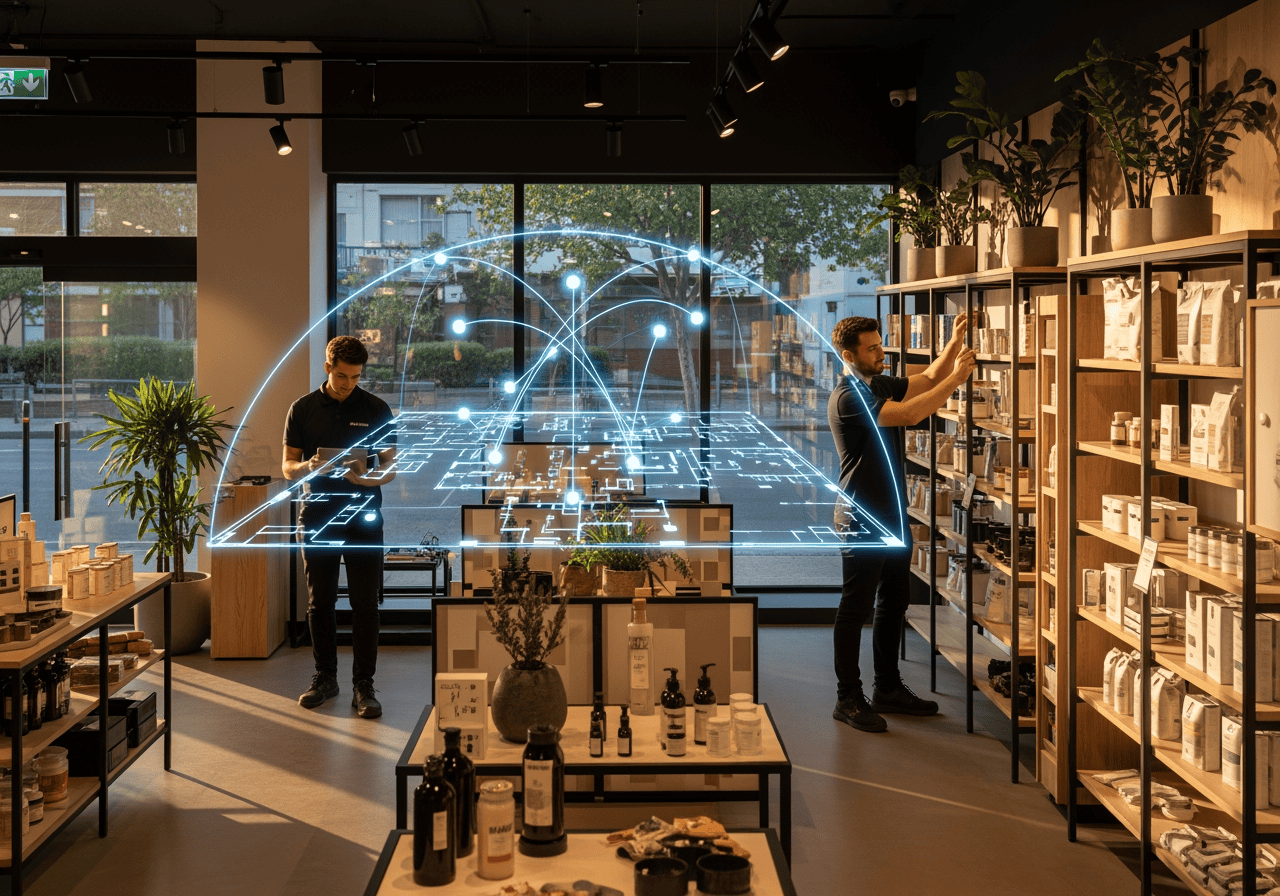
The Business Case for Optimising Retail Layouts with Shopfitting and AI
Optimising a retail layout is an investment that should deliver clear commercial returns. When shopfitting expertise is paired with AI-driven insights, retailers get faster, evidence-based decisions that increase conversion, average transaction value and effective selling space. AiDial’s voice analytics augment traditional metrics by revealing in-store customer intent, hesitation points and staff-customer interactions that are otherwise invisible to POS data alone. That means retailers can validate new floor plans and merchandising changes through controlled experiments rather than costly guesswork, reducing downtime and fit-out rework. The result is an accelerated return on investment: better product placement, improved traffic flow, more efficient staffing and higher sales per square metre. For multi-site retailers the gains multiply, with repeatable layout templates informed by local behaviour signals that scale rollouts while protecting margins and lowering the total cost of ownership for ongoing layout optimisation.
Retailers must balance innovation with responsibility, and data handling is central to that trade-off. AiDial’s platform processes and stores voice and behavioural data exclusively on Australian soil, delivering Australian Data Sovereignty that mitigates regulatory and reputational risks. Local data residency simplifies compliance with the Privacy Act and sector-specific procurement rules, reduces exposure to foreign jurisdictional demands and supports faster incident response through local support teams. For chains supplying government, health or corporate clients, having locally processed analytics can be a procurement differentiator. Shopfitters and retail operations teams can therefore experiment with customer-centred changes and voice-enabled tests confident that sensitive interaction data remains secure, auditable and governed according to Australian standards, protecting customers and the business while enabling innovation.
A strong business case must connect analytics to measurable KPIs. Combining professional shopfitting with AiDial’s voice insights converts qualitative observations into quantitative outcomes such as dwell time, conversion funnels, queue decay and staff responsiveness. By mapping voice-derived cues to POS events and floor plans, retailers can identify bottlenecks, attribute sales uplifts to specific layout changes and optimise staffing schedules based on real demand signals. This creates a closed feedback loop: implement a change, measure its impact in near real time, iterate and scale successful treatments across sites. The practical benefit is reduced waste from ineffective fixtures, improved customer experience and demonstrable efficiency gains that feed directly into P&L improvements. In short, this approach turns layout optimisation from an art into a repeatable, data-driven capability that drives growth and lowers operating costs.
Shopfitting Strategies to Improve Customer Flow and Maximise Sales
Start with the fundamentals: define clear entry and exit points, create unobstructed sightlines to key product categories and promotional areas, and design circulation loops that encourage exploration without causing congestion. Use fixture height and placement strategically so customers can see deeper into the store from the entrance, and ensure aisles are wide enough for comfortable movement while still offering maximum merchandising frontage. Thoughtful lighting, consistent floor finishes and intuitive wayfinding reduce friction, increase dwell time and make impulse purchases more likely — simple shopfitting choices that directly convert into measurable sales uplift when executed well.
Design for flexibility: modular displays, mobile gondolas and adjustable shelving allow teams to rapidly test different planograms and merchandising concepts. Pair these physical tests with rapid A/B measurement so you can scale what works and remove what does not; for example, move a promotional island for a week and compare dwell time and conversion in that zone. Layering AiDial’s AI voice insights on top of these experiments adds a unique dimension — voice-derived signals and in-store behavioural triggers mapped to your floor plan and POS data provide real-time validation of changes, and because AiDial processes and stores that data on Australian soil you get fast, actionable intelligence without compromising customer privacy or regulatory compliance.
Operational details matter as much as visual design: position staff to support natural flow, design checkouts and click-and-collect counters to minimise queuing spill-over into shopping aisles, and use clear signage to reduce decision time. Plan for peak periods with temporary fixtures and customer routing, and ensure accessibility is built into every layout change to broaden your market reach. Integrating AiDial into daily operations lets store teams receive live alerts — for example when a zone becomes congested or when customers frequently call for assistance — so staff can intervene, re-merchandise or open additional tills; again, with Australian Data Sovereignty at the core this insight is delivered securely, helping retailers realise efficiency gains, cost savings and better customer experiences without compromising trust.
How AI Analytics Transform Product Placement and Visual Merchandising
AI analytics convert raw location, POS and AiDial voice-derived signals into intuitive heatmaps that show where customers spend time, where they pause and where queues form. By overlaying these heatmaps on shopfit floor plans, retailers can pinpoint underperforming aisles, overcrowded nodes and wasted display space. That visibility allows targeted shopfitting actions such as widening corridors, repositioning high-margin lines to natural sightlines and redesigning gondolas to reduce friction. Importantly, when AiDial processes voice and behavioural data locally under Australian Data Sovereignty, teams get this insight with lower compliance risk and stronger customer trust. The outcome is measurable: improved customer flow, longer dwell time in priority zones and higher conversion rates at checkout. For multi-store groups, aggregated heatmaps create scalable layout templates that replicate success, while local processing ensures sensitive behavioural patterns remain onshore and under the retailer’s control.
AI analytics make A/B testing of fixtures, signage and planograms fast and empirical, replacing guesswork with measurable uplift data. Retailers can run controlled experiments across stores or within a single store, using AiDial voice cues and POS timestamps to track visit duration, interaction events and conversion by test group. Results are analysed automatically so merchandising teams can learn what layout or display generated the best basket size, product attachment or purchase frequency, then roll changes out quickly. Localised processing via Australian Data Sovereignty means test data does not cross borders, simplifying compliance with privacy rules and preserving customer confidence. Faster iteration reduces time on the shopfloor and staff disruption, lowers the cost of trialling concepts and accelerates real commercial outcomes such as increased sales per square metre and improved labour allocation based on real customer response.
Advanced AI links voice interactions, loyalty data and transaction records to reveal natural product adjacencies and cross-sell moments that visual merchandising can exploit. Insights can highlight which products prompt in-aisle enquiries or which displays trigger multi-item purchases, enabling planogram adjustments that lift average transaction value. AiDial enables this analysis while keeping voice and behavioural intelligence within Australian borders, addressing security and regulatory concerns that matter to Australian businesses and customers. By translating analytics into KPI-aligned actions such as increased attach rate, higher conversion and improved customer satisfaction scores, retailers make a clear business case for investment in shopfitting changes. The result is a cycle of continual improvement where merchandising, operations and analytics teams collaborate to optimise displays for measurable commercial gain while protecting sensitive data onshore.
Applying AiDial’s AI Voice Insights to Understand In-Store Customer Behaviour
AiDials AI voice insights turn everyday in-store interactions into measurable signals that directly inform shopfitting decisions. By analysing speech patterns, tone and spoken intent at different points in the store and linking those signals to floor plan zones and POS data, retailers can see where customers are engaging, hesitating or leaving without purchase. These insights arrive in near real time, allowing merchandisers and store managers to prioritise changes that increase dwell time, reduce friction and capture more leads from conversations where customers express interest in specific products or services.
Practically, AiDial maps voice-derived events onto heatmaps and timelines so teams can spot bottlenecks, understaffed areas and ineffective signage. The platform detects repeated questions about product location or stock, identifies long queue escalation, and measures staff interactions that result in conversion. That enables rapid A/B testing of layout changes and visual merchandising: move a display, run a test day and compare voice and POS metrics to quantify uplift. Faster iteration means lower fit-out and labour costs because each change is guided by data rather than guesswork.
Beyond operational improvement, using AiDial maintains customer trust through strict Australian Data Sovereignty, with all voice processing and storage kept on Australian soil to support privacy compliance and local regulatory requirements. That local-first approach reassures customers and staff, increasing opt-in rates for voice-enabled experiences and improving the quality of captured leads. For retailers, the outcome is tangible: better customer experience, smarter staff allocation, reduced lost sales and clear ROI on shopfitting investments, all underpinned by secure, locally hosted AI voice analytics.
Ensuring Trust and Compliance with Australian Data Sovereignty in AI-Driven Layout Optimisation
Keeping voice and behavioural data on Australian soil simplifies compliance with the Privacy Act and the Australian Privacy Principles, and reduces the legal complexity of cross-border data transfers that can delay procurement or expose retailers to foreign surveillance laws. For retailers and shopfitters working with sensitive customer interactions, AiDials commitment to Australian Data Sovereignty means call audio, transcripts and derived analytics are processed and stored in local data centres, making it straightforward to demonstrate compliance during audits and to satisfy enterprise or government buyers with strict data residency requirements. This local residency reduces contractual risk, lowers the barrier to working with regulated partners and supports clearer breach notification obligations. Ultimately, a sovereign data approach builds trust with customers and stakeholders by aligning privacy promises with tangible, demonstrable practices that meet Australian legal and commercial expectations.
Data sovereignty is only meaningful when paired with strong technical and operational controls. AiDial combines local data residency with end-to-end protections such as encryption in transit and at rest, role-based access controls, secure key management, network segmentation and continuous monitoring hosted in Australian infrastructure. Voice analytics can be performed at the edge or within the local cloud so raw audio does not need to travel offshore, and pseudonymisation or anonymisation routines reduce identification risks in downstream datasets. Operational controls include logging, immutable audit trails and strict retention policies that align with privacy impact assessments. These measures limit exposure to unauthorised access, provide clear forensic evidence if incidents occur and support internal governance frameworks, enabling retailers to derive real-time AI-driven layout insights without sacrificing security or compliance.
Beyond technology, durable trust comes from repeatable policies and disciplined procurement. Retailers should embed privacy-by-design into shopfitting and analytics projects, capture informed consent where required, conduct Data Protection Impact Assessments and codify retention and deletion schedules for voice data. Working with a local AI partner like AiDial makes vendor due diligence and contractual controls simpler: data processing agreements, service level commitments and jurisdictional clauses can explicitly require Australian processing and storage. Regular third-party audits, staff training on handling voice data and a tested incident response plan round out a practical governance programme. These policies reduce commercial friction, reassure customers and insurers, and make it easier to scale AI-driven layout optimisation across stores while maintaining compliance and preserving customer trust.
Practical Steps to Integrate Shopfitting Teams with AiDial Local AI Solutions
Begin with a focused discovery phase that brings shopfitting project leads, store operations, IT and visual merchandising together to set measurable goals such as increased dwell time, reduced bottlenecks and uplift in conversion rates. During this planning stage, map existing floor plans, POS and footfall counter locations so AiDial can advise on optimal placement of discreet voice capture and sensor nodes without disrupting store aesthetics. Agree a pilot scope and timeline, nominate a local project manager and ensure infrastructure needs are captured early so AiDial can provision a local Australian deployment that processes and stores voice and behavioural data on Australian soil, maintaining data sovereignty and simplifying compliance.
Next, run a staged implementation that starts with ingesting CAD or PDF floor plans into AiDial and calibrating voice analytics to your physical space and shopfitting changes. Coordinate installers and shopfit teams to mount devices during non-trading hours, integrate AiDial feeds with POS and loyalty systems for richer event correlation, and set up real-time dashboards and alerting for store managers and merchandisers. Provide practical training and quick reference playbooks for shopfitting crews and store staff so they can run controlled A/B layout tests, capture qualitative feedback and use AiDial insights to iterate layouts rapidly while capturing lead and conversion signals.
Finally, formalise governance, measurement and scaling processes so insights lead to sustained commercial outcomes. Define privacy and consent practices that are visible to customers, assign data access roles, and document how AiDial’s Australian-hosted data meets security and regulatory requirements to build trust with stakeholders. Establish a KPI cadence to assess efficiency and cost savings, tie metrics back to shopfitting activities and use AiDial’s local support to roll successful layout patterns across stores, delivering measurable improvements in customer experience, reduced rework and stronger ROI from visual merchandising investments.
Measuring ROI: Efficiency, Cost Savings and Customer Experience Gains from AI and Shopfitting
Start by establishing a clear set of measurable KPIs that tie shopfitting changes to commercial outcomes. Typical retail metrics include footfall, conversion rate, sales per square metre, average basket value, dwell time in key zones, queue length and service time, plus rate of repeat visits. Layer AiDial voice insights on top of POS and floor plan data to capture customer queries, missed sales calls and in-store voice interactions that indicate intent or friction. Use a baseline period before shopfitting changes, then run controlled A/B tests across matched stores or zones to measure uplift and statistical significance. Track lead capture metrics from voice interactions and link them to POS transactions to attribute revenue. Because AiDial processes and stores data exclusively in Australia, those KPIs remain audit-ready and compliant with local privacy expectations, making performance reporting more robust for stakeholders and easier to validate during optimisation cycles.
Quantify efficiency gains by modelling labour savings, reduced shrinkage, lower customer service handling time and fewer missed sales. AiDial can automate routine voice enquiries and post-visit follow-ups, reducing the need for floor staff to perform repetitive tasks and allowing them to focus on high-value selling. Calculate savings by measuring reduced staff hours, overtime and transaction handling time before and after implementing AI-driven routing and automated voice responses. Include indirect savings such as lower loss prevention costs when improved layouts reduce blind spots and clearer staff allocation improves oversight. Consider compliance and risk reduction savings from Australian Data Sovereignty, including lower potential legal and remediation costs because sensitive voice and behavioural data stay onshore and meet regulatory expectations. Present total operational savings as a combination of direct labour reduction, avoided costs and productivity uplifts to create a realistic ROI projection.
Turn CX gains into a clear revenue story by modelling how small improvements compound across transactions and visits. Use measured uplifts in dwell time, conversion rate and basket size from test stores to estimate incremental monthly revenue per square metre. Apply gross margin to incremental revenue to calculate monthly contribution and divide total implementation cost to estimate payback months. Factor in additional value from lead capture and re-engagement via AiDial voice: recovering missed calls, capturing customer intent in-store and automating follow-up can convert deferred visits into sales and lift lifetime value. Run sensitivity scenarios showing conservative, likely and optimistic outcomes to help commercial teams plan budgets. Throughout, highlight the strategic advantage of onshore data handling under Australian Data Sovereignty, which increases customer trust and response rates, improving the realism of revenue forecasts and shortening payback periods due to better engagement and fewer compliance barriers.


Key Takeaways: Securely Optimise Your Retail Layout with AiDial
Optimising retail layouts with coordinated shopfitting and AI delivers clear commercial outcomes: improved customer flow, smarter product placement, better visual merchandising and measurable uplifts in conversion and basket size. Practical shopfitting strategies combined with AI analytics and AiDial’s voice-driven insights help retailers identify real in-store behaviours, remove friction points, and allocate space where it drives the most sales while reducing wasted fit-out and staffing costs.
AiDial’s local AI voice solutions make these gains secure and compliant by keeping all processing and storage within Australia under Australian Data Sovereignty, which strengthens customer trust and simplifies regulatory requirements. By integrating shopfitting teams with AiDial analytics, following simple implementation steps and tracking defined KPIs, retailers can rapidly demonstrate efficiency, cost savings and better customer experience. Book a Demo with AiDial to see how secure, locally hosted AI voice insights can optimise your retail layout and boost measurable returns.