Across Australia, animal control teams face the persistent problem of delayed responses and missed reports that can endanger public safety and animal welfare, and AiDial’s AI voice solutions help councils and service providers optimise intake and triage so incidents are prioritised and routed faster; by automating initial calls and follow-ups, the system not only speeds response times and improves welfare outcomes but also integrates seamlessly with dispatch and field teams to provide real-time updates and clear handovers, while multi-channel outreach via voice, SMS and web capture more reports and leads that would otherwise be lost; importantly, all of this is delivered with Australian Data Sovereignty at the centre, keeping personal and incident data processed and stored on Australian soil to meet privacy and compliance expectations and build community trust, and the benefits are measurable through reduced response times, lower operating costs and improved service metrics that demonstrate clear efficiency gains and cost savings for councils and providers, making a pilot and phased implementation the logical next step for organisations looking to modernise their animal control operations with a secure, locally supported AI call solution.
The Challenge of Timely Animal Control Responses
Animal control teams regularly face surges in call volume that outstrip available staff, especially after hours and during seasonal peaks. Callers report wandering dogs, wildlife strikes, injured animals and public safety hazards at any time of day, and missed or delayed responses can escalate risk to humans and animals alike. Many councils rely on voicemail systems or ad hoc after-hours arrangements that provide poor information capture and leave incidents unresolved until morning. This not only harms welfare outcomes but also damages public trust and generates avoidable follow up workloads. The scale and timing of demand make manual intake unsustainable for many providers, creating a clear need for automated, always-on intake that captures every report, prioritises urgent cases and reduces response lag while integrating with existing dispatch processes.
Calls to animal control often contain fragmented or inconsistent information, with callers under stress and unsure what details are most important. Manual triage requires skilled staff to clarify species, location, risk level and accessibility, and this back-and-forth consumes time that could be spent in the field. Incomplete records lead to repeat calls, incorrect prioritisation and inefficient dispatching, increasing operational costs and slowing outcomes for animals in distress. Reliance on disparate record systems and manual data entry also increases the chance of human error and lost leads. For councils and service providers looking to optimise response quality, standardised intake that prompts for essential data and reduces rework is critical to improving turnaround times and ensuring the right resource is deployed to the right incident.
Many Australian councils and providers operate with limited budgets and small teams spread across wide geographic areas, making rapid mobilisation difficult. Rural and regional districts face long travel times and sparse coverage, so prioritisation must be accurate to avoid wasted trips. Meanwhile, increasing regulatory expectations around privacy and incident reporting place added demands on how data is handled and retained. Outsourcing call handling or using overseas cloud services can create compliance and reputational risk for organisations bound by Australian law. These practical and legal pressures underscore the advantage of an AI voice solution that not only improves efficiency and triage but also ensures processing and storage remain on Australian soil, helping councils meet regulatory obligations while stretching limited resources further.
How AI Call Solutions Streamline Intake and Triage
AiDial provides AI voice intake that captures reports the moment they are logged, answering calls and web submissions around the clock and guiding callers through concise, structured questions to capture location, animal type, behaviour and severity. The system converts natural speech into standardised incident records and can prompt for photos or GPS links via SMS to enrich reports. By automating these first contact steps, intake is faster, fewer calls are abandoned, and frontline staff receive consistent, high quality information for every case.
Built-in triage logic scores incidents against council rules and risk criteria so urgent matters are surfaced immediately and routine enquiries are scheduled or redirected to self‑service channels. AiDial routes high priority cases to on‑call officers or emergency dispatch, flags complex incidents for human review, and issues confirmations and follow up notifications to the public. This reduces unnecessary patrols, improves officer allocation and shift planning, and lowers operational costs while ensuring urgent welfare and public safety needs are met more reliably.
Crucially, all intake and triage workflows are delivered with Australian Data Sovereignty at the centre, meaning sensitive incident and personal data is processed and stored on Australian soil to meet privacy and regulatory expectations. Local hosting and support make audits, reporting and compliance simpler for councils and service providers, and preserve a secure chain of custody for records used in enforcement or welfare investigations. AiDial also provides dashboards and analytics so teams can measure triage accuracy, response times and continuous improvements, helping justify investment and demonstrate better outcomes to the community.
Improving Public Safety and Animal Welfare with Automated Calls
Automated calls delivered by AiDial can capture critical details immediately after a report is made, allowing councils and animal control teams to triage incidents by severity in seconds. Rather than waiting for an operator to become available, callers receive an intelligent, structured intake that asks the right questions about location, injury status, aggression risk and presence of vulnerable people. That rapid assessment enables prioritisation of truly urgent matters such as injured wildlife on busy roads or aggressive dogs in residential areas, so dispatchers can send the nearest response team with the correct equipment. Crucially, callers also receive immediate, evidence-based safety guidance to reduce harm to people and animals while help is en route, improving outcomes and reducing liability. Because AiDial processes and stores this sensitive incident information under Australian Data Sovereignty, councils retain full control and assurance that personal and location data remain within Australian jurisdiction for security and compliance.
Automated calls standardise how incidents are recorded, eliminating variability in caller interviews and ensuring every report contains the essential facts needed for effective response. AiDial’s voice solution timestamps and logs each response, creating an auditable record that supports transparent decision-making and streamlines handovers to field crews and partner agencies. This consistency reduces miscommunication that can delay care for injured animals or lead to inadequate containment of dangerous fauna, and it helps maintain professional standards across different shifts and teams. When cases escalate, the system can automatically flag high-priority incidents and provide field teams with concise, structured summaries so responders arrive informed and ready. With all data processed and stored in Australia, councils can confidently share incident details with authorised local stakeholders while meeting privacy and regulatory obligations.
Automated follow-up calls and messages from AiDial help track the welfare of animals after initial intervention and keep the community informed, which is essential for long-term safety and trust. For instance, a follow-up call can confirm the condition of an injured animal, check whether containment measures remain effective, or remind residents about next steps and fines where relevant. This ongoing engagement increases the likelihood of successful reunions for lost pets, improves rehabilitation outcomes for wildlife, and deters repeat offending through consistent communication. It also frees animal control staff from routine administrative follow-ups, allowing them to focus on fieldwork. Maintaining these records within Australia reinforces public confidence in the system, ensuring sensitive follow-up information is handled under Australian Data Sovereignty and consistent local governance.
Integrating AI Voice with Dispatch and Field Teams
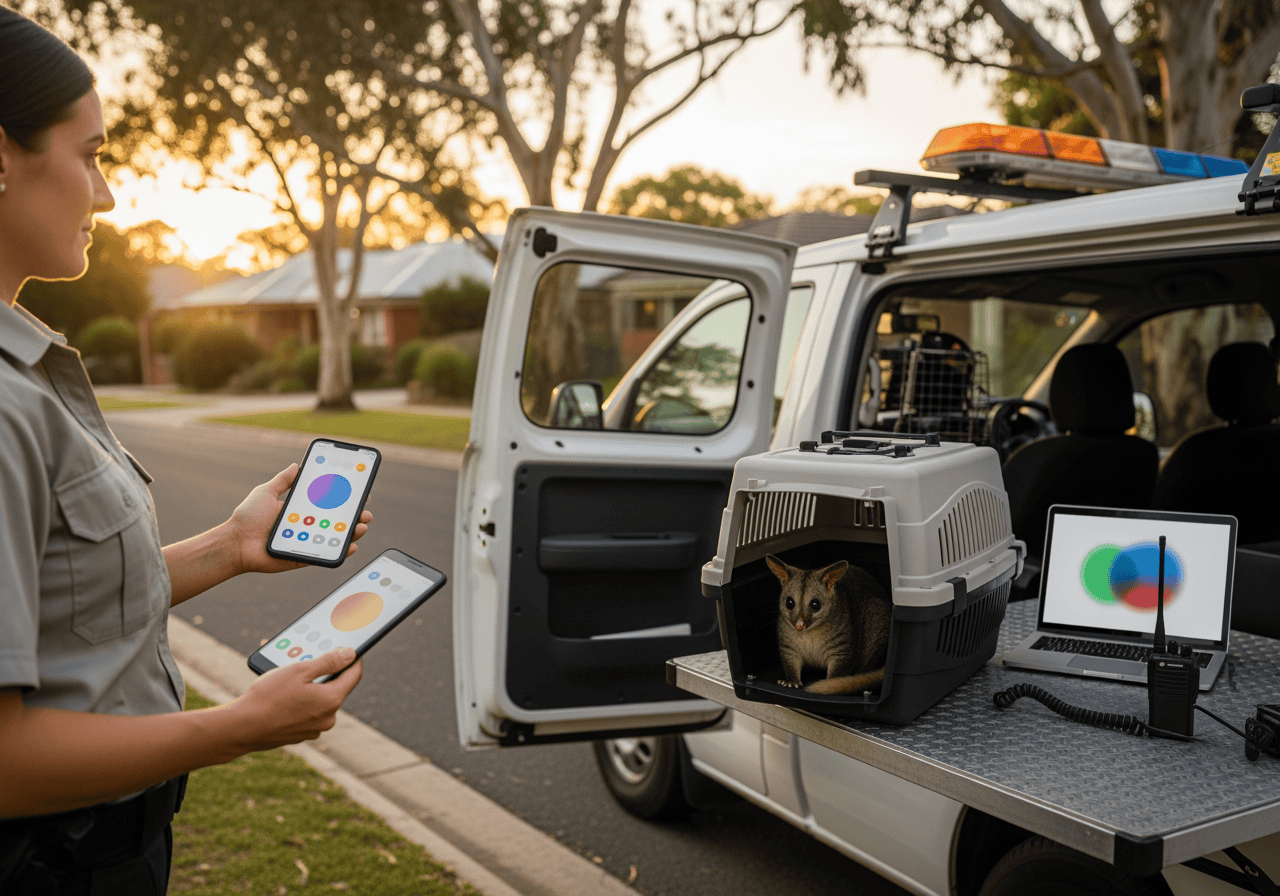
AiDial connects AI voice intake directly into dispatch platforms and mobile field devices so every report becomes an actionable handover instead of a note to be chased. As soon as an automated call captures key details and priority level, the system generates a concise, searchable incident summary with location coordinates, caller contact, and any attached media, pushing that packet to the council dispatch board or rangers via SMS, push notification or standard CAD/RMS integration. This removes time-consuming manual data entry and ensures crews arrive with accurate context on first attendance.
Real-time two-way updates keep situational awareness live: field teams can acknowledge, update status, add photos or request further information which immediately syncs back to the central dashboard and the original case record. That closed-loop communication reduces double-handling, prevents duplicate tasks, and helps managers allocate resources more efficiently across concurrent incidents, delivering measurable improvements in response time and lower operational costs for councils and service providers.
All of this is delivered with Australian Data Sovereignty at the centre so sensitive caller and incident data are processed and stored onshore, preserving privacy and simplifying compliance with state and federal regulations. The local data residency also creates a reliable audit trail for incident reviews and legal requirements while enabling secure API integrations with existing dispatch and reporting systems, so councils can adopt AiDial with minimal disruption and immediate operational benefit.
Capturing Reports and Leads Through Multi-Channel Outreach
Councils and animal control providers miss critical reports outside business hours; a multi-channel approach fixes that by meeting the community where they are. AiDial combines conversational AI voice bots with SMS and mobile-friendly web capture so callers, texters and web visitors can lodge incidents any time. Voice bots capture rich, structured details during calls while SMS captures quick incident reports and enables two-way clarifications, and web forms gather photos and location data for faster identification. The integrated capture stack increases total reports and leads by reducing abandonment and giving people convenient options for different situations. Importantly, all interactions, transcripts and attachments are processed and stored under Australian Data Sovereignty, which builds public trust and keeps sensitive location and personal data within Australian jurisdiction for compliance and security.
Capturing a report is only the first step; converting it into a timely response requires personalised follow-up. AiDial automatically sends tailored SMS confirmations, voice callbacks or web links based on incident type and severity, prompting users for missing details and providing clear expectations about response times. For lost pet leads, automated reunification workflows nudge finders to submit photos and vets to confirm ownership, speeding resolution. Two-way messaging and scheduled AI-driven callbacks reduce repeated manual phone chasing, freeing staff to focus on field response. Personalisation increases completion rates, turning passive reports into actionable leads and measurable outcomes. With data processed onshore under Australian Data Sovereignty, councils can confidently use personal contact details for follow-up without exposing citizen data to overseas risk.
To turn captured reports into operational value, multi-channel data must feed dispatch, CRM and analytics in real time. AiDial consolidates voice transcripts, SMS threads and web submissions into a unified incident record that integrates with existing dispatch systems and council databases, enabling automatic triage, prioritisation and field handovers. Consolidation improves conversion tracking, response metrics and cost analysis so councils can quantify efficiency gains and reduce duplicate effort. Crucially, this integration is designed around Australian Data Sovereignty: APIs, storage and processing remain on Australian soil, simplifying compliance with privacy regulations and procurement policies while maintaining audit trails and secure access controls. That combination of seamless workflow integration and onshore data governance delivers both operational efficiency and local accountability.
Ensuring Security and Compliance with Australian Data Sovereignty
Australian Data Sovereignty means that incident and personal information is processed, transmitted and stored exclusively on Australian soil, which matters for animal control where caller details, location data and welfare reports can be sensitive. Keeping data local reduces the legal complexity of cross-border transfers and helps councils and service providers meet the Australian Privacy Principles and Notifiable Data Breaches obligations under the Privacy Act. For local government procurement and contract management, a sovereign data approach simplifies compliance with state and council policies and reduces the risk of unexpected foreign jurisdiction access to critical records.
AiDial embeds sovereignty into the technical design by hosting systems in certified Australian data centres and applying security controls such as encryption in transit and at rest, strict role based access, multi factor authentication and comprehensive audit trails. Integrations with dispatch and records management systems are built on secure APIs that preserve data residency, and retention and deletion policies are configurable to align with council retention schedules. These measures make it straightforward to produce audit logs for internal reviews and regulators without exposing data offshore.
The practical benefits for animal control teams include lower legal and reputational risk, faster response to compliance requests and simpler vendor approvals, which together free up resources to focus on operational priorities. Local hosting also delivers quicker incident recovery and Australian based support and service level agreements that understand council needs and local emergency timelines. By centring Australian Data Sovereignty, AiDial helps councils and providers safeguard community trust while delivering the efficiency and reliability needed to improve public safety and animal welfare.
Measuring Efficiency Gains and Cost Savings for Councils and Providers
Councils and animal control providers should measure a focused set of operational metrics to quantify efficiency gains from AI call solutions. Essential indicators include average time to answer, time to triage, percentage of incidents captured via automated intake, first-contact resolution rate, calls handled per hour per agent or virtual assistant, and reduction in missed reports. Track downstream effects such as average response time for field crews and proportion of priority incidents escalated correctly. AiDial supplies real-time dashboards and exportable reports that make these metrics visible and comparable to baseline performance. Because all processing and storage occur under Australian Data Sovereignty, reporting can be shared confidently with elected officials and auditors without cross-border data risk, ensuring compliance with local privacy obligations while giving decision-makers a clear, objective view of service improvements.
Translating operational changes into dollar savings requires accounting for both direct labour reductions and indirect efficiencies. Direct savings come from fewer full-time equivalent hours needed for 24/7 intake and fewer overtime shifts thanks to AI handling routine calls and follow-ups. Indirect savings include reduced unnecessary dispatches, lower administrative handover time, decreased field crew idle time, and fewer repeat calls. A practical calculation multiplies FTE hours saved by fully loaded labour cost and adds avoided vehicle and fuel costs from prevented non-essential dispatches. AiDial helps by quantifying calls handled autonomously, average handling time saved, and reductions in repeat contacts, enabling finance teams to build conservative and stretch-case savings estimates. Maintaining Australian Data Sovereignty strengthens budget approvals by ensuring cost-benefit analysis does not rely on offshore systems that carry hidden compliance costs.
Procuring AI for public services is best done through short pilots that establish baseline KPIs, implement AiDial for a defined cohort, and measure uplift over a 60 to 90 day window. Key outcomes for ROI are reduced cost per contact, faster average response times, and fewer missed or delayed incidents; these translate into a clear payback period and net present value for procurement boards. AiDial supports this approach with audit-ready logs, configurable reporting and integration data for dispatch systems, allowing councils to demonstrate both financial and service improvements to stakeholders. Continuous improvement is achieved by iterating intent models and scripts based on real call patterns, increasing automation rates over time. Crucially, delivering this evidence while keeping all data onshore under Australian Data Sovereignty removes procurement friction and builds public trust in the initiative.



Key Takeaways and Next Steps for Implementing AI Call Solutions
AI call solutions offer animal control teams a practical way to reduce response times, streamline intake and triage, and improve outcomes for both the public and animals. Automated voice follow-ups and multi-channel outreach help capture more reports and leads while freeing dispatchers to focus on urgent incidents, delivering measurable efficiency gains and cost savings for councils and service providers. Integrating AI voice with existing dispatch and field teams ensures better coordination and situational awareness, and the same approach is proving effective across other sectors such as Dog Training Schools Optimise Enrolments with AI Calls and Public Transport Services: Optimising Operations with AI.
When implementing AI call solutions, start with a small pilot, define clear KPIs for response time, case resolution and cost per call, and ensure seamless integration with your dispatch systems and mobile workflows. Critically, choose a partner that guarantees Australian Data Sovereignty so sensitive community and incident data is processed and stored on Australian soil for maximum security, compliance and public trust. To explore a tailored rollout for your organisation, Book a Demo or Contact Us for a Consultation.