AI voice technology is reshaping how security providers operate by automating alarm verification, supporting incident triage and enabling remote guard assistance to reduce false alarms, speed response times and deliver tangible efficiency gains and cost savings; when paired with consistent, clear communications it also strengthens client confidence, while robust voice recognition and proven performance in noisy, real-world conditions ensure technical reliability for frontline teams. Equally important is the way these capabilities integrate with existing security platforms, workflows and on-the-ground staff so they augment rather than disrupt operations, and by keeping voice processing and data storage exclusively on Australian soil organisations gain a crucial advantage in compliance, security and client trust. AiDial specialises in delivering on these outcomes with onshore processing and storage to meet Australian data sovereignty expectations, making it straightforward for businesses to adopt AI voice solutions that centre privacy, reliability and operational value. This post will unpack practical use cases, performance considerations and integration approaches and finish with clear, actionable takeaways for security providers looking to implement AI voice safely and effectively.
Why AI Voice Matters for Security Services
False alarms are a major operational and financial burden for security providers, generating unnecessary patrols, labour costs and client frustration. AI voice solutions matter because they automate the first stages of verification with consistent, human-like interactions that quickly confirm whether an event is real or benign. By deploying scripted voice checks, contextual questions and audio analysis, AI can rule out common triggers such as pets, weather or equipment faults before a guard is dispatched. That reduces wasted response activity, lowers call handling times and frees staff to focus on genuine incidents. For Australian security firms, AiDial’s onshore AI voice systems deliver these efficiency gains while ensuring sensitive audio and verification data never leave Australia, preserving evidentiary integrity and client confidentiality. The result is measurable cost savings, fewer false call-outs and a more reliable verification process that aligns with operational priorities and contractual obligations.
Security demand is continuous and unpredictable, yet human teams are finite and prone to fatigue. AI voice solutions provide scalable, round-the-clock coverage that maintains consistent quality regardless of call volumes or time of day. A virtual remote guard can handle initial triage, execute escalation protocols, and hand over to on-site teams or emergency services when required, ensuring faster mean time to acknowledgement and more reliable service levels. This consistency improves client confidence and reduces the risk of missed or delayed responses during peak incidents. AiDial’s platform integrates with control room software and patrol management systems to augment existing workflows rather than replace them, enabling hybrid human-AI operations that maximise resource efficiency. Because processing and storage are kept on Australian soil, organisations benefit from predictable latency, dependable uptime and local support that keeps mission-critical services resilient.
Voice interactions capture highly sensitive information, including personal details and potentially identifiable audio; how that data is handled is central to legal compliance and client trust. AI voice matters because it must meet stringent privacy, regulatory and evidentiary standards. For Australian security providers, onshore processing and storage is especially important: it mitigates exposure to foreign government access regimes, simplifies audits and incident investigations, and supports compliance with local privacy laws and industry-specific requirements. AiDial’s commitment to Australian Data Sovereignty means conversations, transcriptions and derived metadata remain within national borders, giving organisations a clear chain of custody and stronger data governance. This local assurance reduces legal risk, enhances reputational trust with corporate and government clients, and strengthens bids for contracts where data residency is a mandatory criterion.
Practical Use Cases: Alarm Verification, Incident Triage and Remote Guard Support
Automated alarm verification is one of the most immediate wins for security providers, and AI voice makes it practical at scale. AiDial provides conversational voice flows that call a triggered site, prompt simple verification responses, listen for contextual audio cues such as voices or glass break, and apply confidence scoring so operators know which events require human attention. The result is a measurable reduction in false alarms, lower mobilisation costs and faster, better informed dispatch decisions, all while integrating seamlessly with existing monitoring platforms. Crucially, all voice interactions and verification recordings are processed and stored on Australian soil, supporting Australian data sovereignty and meeting the compliance requirements of clients and regulators.
Incident triage benefits from AI voice by turning unstructured incident calls into structured, actionable records. AiDial solutions capture short, reliable transcripts and metadata during initial contact, classify severity and likelihood, and automatically route incidents to the right team or escalation path, reducing manual triage time and operator workload. This structured approach speeds resolution, improves handover quality for on‑site guards or emergency services, and creates an auditable trail for insurers and clients. Maintaining that incident data within Australia reinforces chain of custody, supports privacy obligations and exemplifies Australian data sovereignty in practice.
Remote guard support is transformed when AI voice acts as an always‑available partner for field teams. AiDial can provide two‑way voice assistance for remote inspections, walk guards through standard operating procedures, generate on the spot checklists, and capture evidence for later review, enabling fewer unnecessary patrols and smarter allocation of labour. The technology also enables on‑demand escalation to human supervisors when nuance or judgment is required, preserving service quality while cutting response times and costs. End to end, interactions and analytics remain within Australian jurisdiction, ensuring clients can rely on strong security controls, local support and the protections of Australian data sovereignty.
Operational Benefits: Efficiency, Cost Savings and Faster Response
AI voice verification dramatically cuts the hours spent chasing false alarms by automating initial checks and prioritising genuine incidents. AiDial’s voice agents can conduct structured, conversational verifications with alarm sources, rapidly distinguishing fault conditions from real threats and reducing unnecessary patrols and callouts. The result is measurable efficiency gains for control rooms and field teams, with lower vehicle and labour costs and better allocation of guards to high-risk events. Because voice processing and recordings remain under Australian Data Sovereignty, sensitive verification records are stored and processed locally, satisfying insurance and regulatory requirements while preserving client trust. This local assurance reduces legal complexity and the risk of cross-border data exposure that can inflate compliance costs. For security providers, the knock-on benefits include improved staff productivity, fewer overtime hours, and demonstrable reporting to clients that shows reduced false alarm rates and clear cost savings driven by AiDial implementation.
Faster response hinges on clear, timely information flow; AiDial ties AI voice interactions directly into existing incident management workflows so critical details reach dispatchers and field teams without delay. Automated escalation logic, voice-to-text summaries and priority tagging ensure the right personnel are notified with actionable intelligence, shaving minutes off decision time and mobilising resources more effectively. This speed translates into better outcomes for clients and lower liability exposure for providers because incidents are assessed and responded to sooner. Localised processing under Australian Data Sovereignty means that all voice transcripts and decision logs used in response workflows stay within national borders, simplifying audit trails and ensuring compliance with sector standards. By integrating with alarm systems, CRM and mobile dispatch tools, AiDial enables a seamless, rapid chain of response that improves key performance indicators such as time-to-acknowledge and time-to-on-site.
AI voice solutions offer continuous, cost-effective coverage that scales with demand, allowing providers to expand capacity without proportionally increasing wage bills or infrastructure. AiDial’s platform can handle high call volumes during peak periods, route complex cases to human operators and maintain service quality around the clock, reducing reliance on expensive after-hours staffing. Over time this capability lowers cost-per-incident and provides predictable operational expenditure that supports growth and competitive pricing. Crucially, with Australian Data Sovereignty baked into the solution, scaling does not mean moving data offshore or introducing third-party jurisdictions, preserving data security and meeting procurement requirements for many enterprise and government contracts. Local processing also enables faster support and customisation from Australian-based teams, so scaling remains operationally smooth and aligned with domestic compliance expectations while delivering tangible savings and improved service availability.
Enhancing Client Trust with Consistent, Clear Communications
When an alarm is triggered or an incident unfolds, the way information is communicated can make the difference between calm, cooperative clients and confused, anxious stakeholders. AiDial’s AI voice solutions deliver consistent, scripted communications that are clear, professional and empathetic, ensuring every notification follows the same high standard whether it is an automated alarm verification call, an update on officer arrival or instructions during an incident. Personalisation is preserved through CRM integration, so messages remain relevant and reassuring, while natural Australian voice profiles increase clarity and rapport with local customers across diverse environments and times of day.
Consistent communications also create a verifiable record that supports transparency and accountability. AiDial captures time-stamped voice interactions and generates accurate transcripts and summaries that can be used for incident review, client reporting and dispute resolution, giving clients confidence that responses are prompt and procedures were followed. Crucially, these records are processed and stored exclusively in Australia, so clients and regulators can rely on Australian Data Sovereignty for privacy, chain-of-custody and compliance obligations without the complexity and risk of offshore data transfers.
The business outcomes are tangible: clearer, predictable communications reduce follow-up enquiries and complaints, improve perceived service levels and strengthen long-term client relationships, which in turn lowers churn and supports repeat revenue. For security providers this means fewer resources tied up in ad hoc phone calls, faster verification cycles and better SLA performance, all while maintaining local control of sensitive voice data. By combining reliable messaging, seamless system integration and the assurance of Australian data residency, AiDial helps security organisations deliver the consistent communications that build trust and differentiate their service proposition.
Technical Reliability: Voice Recognition and Performance in Real-World Conditions
Security operations require voice recognition that works reliably in cars, control rooms, industrial sites and crowded public spaces. AiDial uses speech models trained on diverse Australian acoustic environments and local accents so recognition accuracy holds up amid sirens, machinery, wind and overlapping speakers. Techniques such as beamforming, adaptive noise suppression and speaker diarisation reduce false transcriptions and improve speaker verification for on-call guards and remote operators. The practical outcome for security providers is fewer false alarms, clearer agent-to-client handovers and reduced need for manual review, which saves time and cost. Because AiDial trains and refines these models using data processed and stored in Australia, clients benefit from models optimised for local conditions while keeping sensitive voice data under Australian data sovereignty for compliance, auditability and stronger client trust.
Fast, predictable response times are essential when a voice interaction triggers an alarm verification or incident escalation. AiDial designs low-latency pipelines and hybrid architectures that can run critical voice processing at the edge or in local Australian data centres to maintain service continuity when network conditions fluctuate. Real-time streaming transcription and intent detection minimise delays between a caller making a report and the security operator receiving actionable information, enabling quicker dispatch decisions. Redundant routing, on-device fallbacks and graceful degradation ensure degraded connectivity does not translate to missed calls or lost evidence. Keeping processing and storage within Australia also reduces round-trip times and ensures resilience aligns with regulatory obligations, so organisations secure both performance and compliance without compromise.
Security workflows use specialised terminology, property names, alarm codes and colloquialisms that generic speech models may misinterpret. AiDial supports custom vocabularies, tailored language models and human-in-the-loop validation so accuracy improves over time for each client and site. Importantly, iterative model updates follow privacy-first practices: voice samples for retraining are anonymised, processed and retained exclusively on Australian infrastructure, satisfying data sovereignty requirements and internal governance. This localised lifecycle enables faster tuning cycles, measurable reductions in misclassifications and better capture of critical leads or incident details without exposing data overseas. The result is a continually improving system that boosts operational efficiency, strengthens incident evidence quality and preserves stakeholder trust through strict Australian data control.
Australian Data Sovereignty: Why Local Processing and Storage Are Critical for Security Providers
For security providers operating in Australia, data sovereignty is not a niche legal point but a practical compliance requirement. Processing and storing voice recordings and metadata on Australian soil helps satisfy obligations under the Privacy Act and state-level privacy rules, reduces the complexity of cross-border data transfer provisions and meets the expectations of clients in regulated sectors, including critical infrastructure and government. Local processing also minimises exposure to foreign legal regimes that can compel access to data, giving security teams clearer control over who can lawfully request or obtain sensitive incident recordings.
Beyond legal concerns, keeping voice processing and storage within Australia strengthens operational security and incident response. Local hosting enables organisations to retain full control of encryption keys, access logs and forensic data, which accelerates breach investigations and mitigations. It also reduces latency for real-time voice interactions, maintains service continuity when international routes are disrupted and narrows the attack surface associated with transnational data transfers, all of which are vital for alarm verification, urgent triage and remote guard support where seconds matter.
From a commercial and reputational perspective, Australian data sovereignty translates into demonstrable trust for clients and procurement teams. Organisations that can show end-to-end local data handling are more likely to win contracts with government and enterprise customers that mandate Australian residency for sensitive information. AiDial processes and stores voice data exclusively on Australian soil, combining local compliance assurance with resilient, low-latency call automation and Australian-based support, helping security providers optimise response times, reduce risk and strengthen client confidence.
Integrating AI Voice with Existing Systems, Processes and Teams
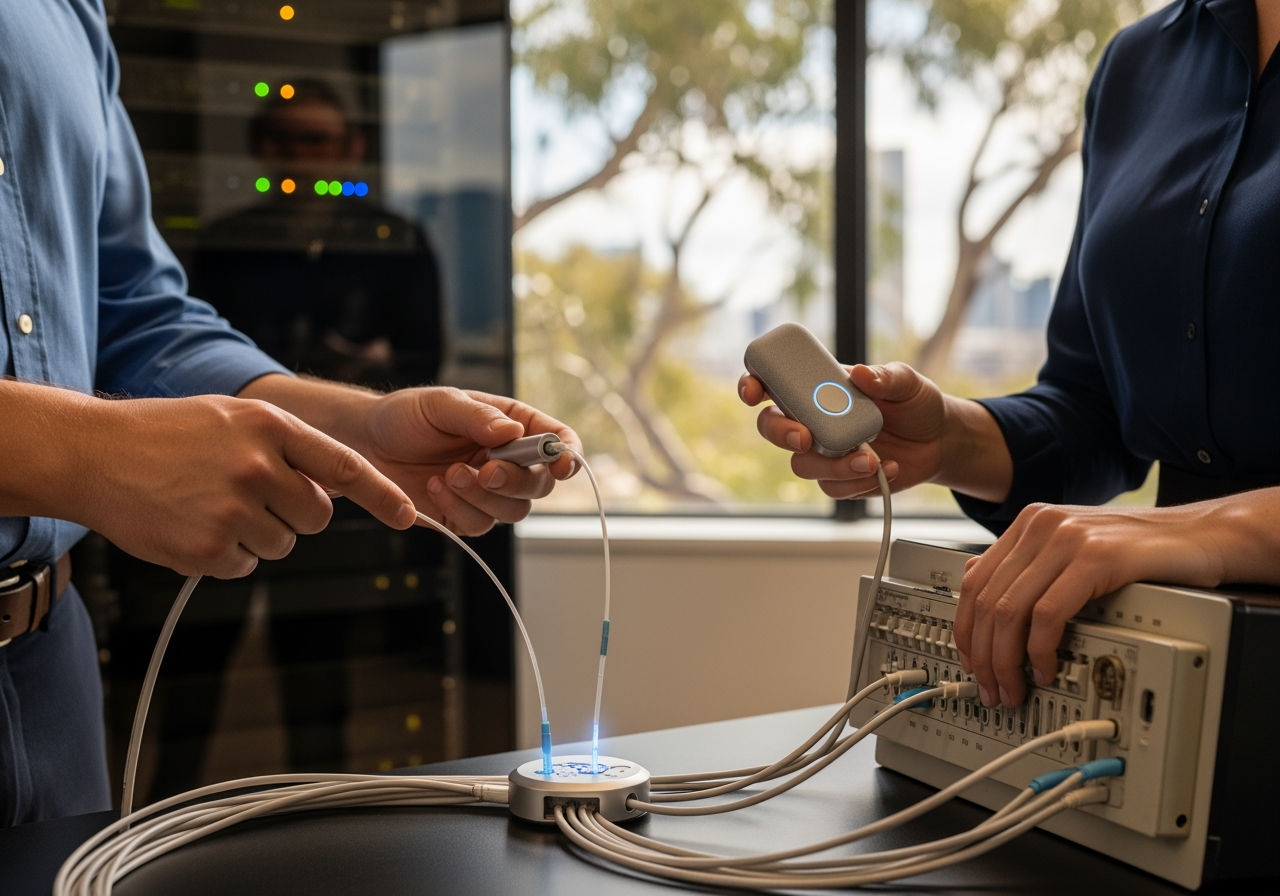
Integrating AI voice into an existing security estate begins with practical, standards-based connections rather than rip-and-replace projects. AiDial supports SIP trunking, secure APIs, webhooks and common protocols used by PSIMs, VMS, RMS and access control systems so alarm events, camera feeds and incident metadata can be correlated and acted upon in real time. Bi-directional links let the AI initiate verification calls or receive guard updates and then feed structured outcomes back into incident records, dispatch systems and client portals. Crucially, keeping voice processing and data storage on Australian soil means integration avoids cross-border data transfers that complicate compliance with local privacy and industry regulations. That local data residency also simplifies vendor contracts and reduces latency for voice interactions, improving reliability. By providing documented connectors and partner enablement, AiDial makes technical integration predictable and low-risk, enabling security providers to preserve existing investments while unlocking automation and consistent incident handling.
Successful integration is as much about people and processes as technology. AiDial works with security managers to map existing control room workflows, alarm verification scripts and escalation policies, then configures AI voice interactions to mirror those operational steps so the technology augments rather than replaces staff. Human-in-the-loop controls allow operators to review and override AI decisions, and role-based access plus tamper-evident audit logs preserve accountability. Training materials and scenario-based coaching help controllers and mobile guards gain confidence in the assistant, while editable conversation templates let teams tailor tone and prompts to client expectations. With all voice data processed and stored in Australia, staff and clients retain trust that sensitive incident details remain subject to local governance. This alignment reduces operational friction, lowers onboarding time, and drives measurable improvements in response times and false alarm reduction without compromising human oversight.
Adopting AI voice should be iterative: pilot, measure, refine, then scale. AiDial advocates a phased rollout starting with targeted use cases such as alarm verification or routine client check-ins, running the AI in parallel with existing procedures to validate accuracy and KPIs like verification rates and dispatch reductions. Detailed dashboards and incident transcripts make it easy to tune conversation flows and escalate edge cases to training datasets, improving performance over time. Because AiDial hosts all processing in Australia, updates, backups and disaster recovery are managed under local SLAs and regulatory frameworks, providing predictable availability and compliance. Local support teams collaborate directly with operations to resolve issues and introduce enhancements, ensuring the solution remains aligned to business objectives. This approach delivers steady operational gains, cost efficiencies and stronger client outcomes while maintaining the assurance of Australian data sovereignty.



Conclusion and Key Takeaways
AI voice is a practical, high‑value tool for security providers: it automates alarm verification, supports incident triage and remote guard assistance, and delivers consistent, clear communications that build client trust. The tangible operational benefits include improved efficiency, lower costs and faster response times, while robust voice recognition tuned for real‑world conditions maintains reliability across noisy or complex environments. Crucially, AiDial combines these capabilities with Australian Data Sovereignty so all voice processing and storage stays on Australian soil, giving security teams stronger protection, simpler compliance and greater customer confidence.
Implementation can be phased to integrate with your existing systems, processes and teams while delivering measurable ROI and improved service outcomes; for cross‑sector examples of local AI delivering similar benefits, see Agricultural Finance: Smart Lending for Australian Farmers, Test Preparation Centers: Boost Enrolments and Efficiency and Carbon Credit Trading: How Australian Businesses Can Benefit. Contact us for a consultation or book a demo to explore how AiDial can secure, optimise and future‑proof your security operations with locally‑hosted AI voice solutions.