Ensuring workplace safety and compliance starts with a clear grasp of Australian first aid obligations under WHS law and a practical assessment of the specific risks at your site so you can determine required staffing levels, training and equipment. Choosing accredited Australian providers ensures staff gain the practical first aid skills they need, whether through onsite sessions, blended learning or eLearning, and helps you specify appropriate first aid kits and automated external defibrillators for your workplace. Maintaining accurate records, scheduling refresher training and holding compliance documentation are essential to demonstrate due diligence and reduce business risk. AiDial’s AI voice solutions can streamline those tasks by automating attendance tracking, incident logging, reminders and secure onshore storage of training and incident records, delivering efficiency gains, lower administrative costs and faster emergency response while preserving Australian data sovereignty to meet privacy and procurement expectations and build trust with employees and regulators.
Understanding Australian First Aid and WHS Legal Obligations
Under Australian work health and safety law the primary duty to ensure first aid provision sits with the person conducting a business or undertaking (PCBU). Officers, managers and supervisors share responsibilities to exercise due diligence and to ensure the PCBU complies with its duties. Workers and contractors also have obligations to follow reasonable safety directions, report incidents and participate in training. State and territory regulators provide specific guidance and expectations, but the core principle is risk-based: first aid arrangements must match the nature and scale of the work activity. For businesses this means assessing your workplace hazards, rostering suitably trained staff, and ensuring facilities and equipment are available and maintained. Demonstrating active management of these responsibilities is critical when regulators or insurers review your practices, and it forms the basis of legal compliance and good workplace safety culture.
WHS law does not prescribe one-size-fits-all checklists; rather it requires employers to implement adequate first aid measures proportionate to workplace risks. Practically this includes providing appropriate first aid kits and supplies, identifying and training an adequate number of staff in accredited first aid competencies, ensuring access to emergency telecommunications and automated external defibrillators where required, and making facilities accessible during all shifts. Considerations such as remote or regional sites, lone workers, hazardous operations and high staff turnover will increase required provisioning. Employers must also ensure that first aid signage is visible and that equipment is regularly inspected and restocked. Engaging accredited Australian providers for training ensures staff gain recognised skills and that course content aligns with local regulators, supporting both legal compliance and genuinely safer outcomes for workers and visitors.
Maintaining accurate and timely records is essential to demonstrate compliance and due diligence. This includes training attendance and competencies, incident and near-miss logs, AED maintenance and supply restock records, and documented risk assessments and response plans. Good records make regulatory inspections, insurance claims and internal reviews more efficient and reduce legal exposure. AiDial’s AI voice solutions can streamline these tasks by automating attendance capture, logging incidents via secure voice prompts, sending scheduled reminders for refresher training and equipment checks, and integrating records with HR and safety management systems. Crucially, AiDial operates with Australian Data Sovereignty so voice and compliance data are processed and stored on Australian soil, strengthening security, meeting local privacy expectations and giving organisations confidence their safety records are managed in a compliant and trusted way.
Assessing Workplace Risks to Determine First Aid Needs
A practical risk assessment starts by identifying the specific hazards, tasks and environments that could cause injury at your site, and then considering the likelihood and potential severity of those incidents. Look beyond generic checklists: account for shift patterns, lone or remote workers, on-site visitors, contractors and high-risk activities such as manual handling, working at heights or hazardous substances. Use WHS legal obligations and relevant codes of practice to translate those risks into clear first aid requirements — for example the number and training level of first aid officers, proximity to ambulance services, response time targets and the type and quantity of first aid kits and AEDs required.
Conduct assessments through a combination of site inspections, worker consultation, review of past incident and near-miss records, and simple performance measures such as expected response times to serious injury. Capture this information in a structured way so you can justify staffing and equipment decisions; documented rationale is essential for demonstrating due diligence to regulators and insurers. AiDial’s AI voice solutions can streamline the data collection and analysis part of this process by automating incident logging, recording verbal site observations and populating assessment forms — while maintaining Australian Data Sovereignty so sensitive health and safety data is processed and stored on Australian soil for security and compliance.
Doing a thorough, evidence-based risk assessment pays off in lower injury rates, reduced downtime, leaner and more targeted first aid resourcing, and stronger outcomes in audits and insurance reviews. Ongoing monitoring and periodic reassessment let you optimise training refresh cycles and equipment placement as workplace conditions change. With AiDial you can automate recurring checklists, receive alerts when incidents indicate changing risk profiles, and produce timely reports that demonstrate compliance and continuous improvement — all supported by the trust and legal clarity that comes from keeping data within Australia under Australian Data Sovereignty.
Choosing Accredited First Aid Training Providers in Australia
When selecting a provider, prioritise Registered Training Organisations that deliver nationally recognised HLTAID first aid units and are regulated by the Australian Skills Quality Authority. Confirm the provider issues the correct unit codes for your workplace needs such as HLTAID011 Provide First Aid or HLTAID009 Provide Cardiopulmonary Resuscitation and check that trainers maintain current first aid currency and assessor qualifications. Ask for evidence of practical assessment processes, trainer to participant ratios for hands‑on practice, and the use of industry‑standard equipment including AEDs. A reputable provider will align course content with Safe Work Australia guidance and be able to demonstrate experience in your sector. Verifying these accreditation and competency details reduces the risk of non‑compliant training outcomes and ensures staff receive reliable, auditable certification that stands up to regulator scrutiny and workplace safety obligations.
Good providers adapt training to your specific hazards, workforce profile and operational context, blending scenario‑based practical sessions with eLearning theory where appropriate. For high‑risk industries, ensure the provider offers realistic simulations, industry‑specific case studies and assessments that test decision making under pressure rather than purely theoretical knowledge. Check options for onsite delivery to ensure learning transfers to the actual work environment, and confirm refreshers and bridged competencies are available to keep staff up to date. Integration with workplace rostering and staggered sessions helps maintain operations while training occurs. To reduce administrative friction, consider providers that can integrate with tools like AiDial’s AI voice solutions to automate bookings, attendance capture and immediate competency confirmation, saving manager time and improving training uptake without compromising learning quality.
Maintaining accurate, accessible training records is essential for WHS compliance and audit readiness. Choose providers who issue secure digital statements of attainment and can export training data to HR or LMS systems in a format suitable for audits. Pay particular attention to how training records and personal data are stored and processed. Australian data sovereignty matters because local storage and processing subject your records to Australian privacy laws and reduces exposure to transnational data risks. Providers that partner with AiDial bring automated incident logging, refresher reminders and attendance verification while ensuring all voice interactions and records remain on Australian soil. This approach streamlines compliance, reduces administrative overhead, and gives employers confidence that sensitive training and incident data are handled securely and in line with local regulations.
Practical First Aid Skills Every Staff Member Should Know
Every staff member should be confident in the fundamentals that make the difference in those first critical minutes: recognising danger and making the scene safe, checking for response and breathing, calling for help, and beginning CPR and defibrillation when required. Practical skills include managing choking, controlling severe bleeding, treating for shock, basic burn care, and immobilising suspected fractures. Knowing where the nearest automated external defibrillator is located and how to fetch and apply it is essential for almost every workplace. These core skills reduce loss of life and limit injury severity while dedicated first aid officers provide more advanced care.
Practical competency comes from hands-on practice and scenario-based drills that reflect the actual hazards on site, whether that is manual handling risks in a warehouse, chemical exposure in a workshop, or slips and falls in an office. Staff should be trained in infection control and correct use of personal protective equipment, restocking and using the workplace first aid kit, and clear incident escalation pathways so they know when to hand over care to a trained first aider or emergency services. Regular refresher training and short toolbox sessions help maintain confidence and muscle memory, and can be tailored to the specific risk profile identified in a workplace risk assessment.
From a business perspective these practical skills translate into quicker response times, reduced injury severity, and stronger evidence of due diligence for WHS compliance and insurance purposes. AiDial’s AI voice solutions can support this by automating training attendance tracking, issuing timely refresher reminders, logging incidents with voice capture at the scene, and initiating emergency contact workflows to reduce administrative lag after an incident. Crucially, all data captured and processed is kept under Australian Data Sovereignty, meaning records are stored and managed on Australian soil to help meet regulatory requirements and maintain trust with employees and stakeholders while you optimise compliance workflows.
Training Formats: Onsite, Blended and eLearning Options
Onsite first aid training remains the gold standard for workplaces that need staff to demonstrate hands-on skills such as CPR, choking relief and AED use. Delivered at your site, it allows instructors to tailor scenarios to your actual hazards, machinery and work environment so trainees gain confidence in context. Onsite sessions also simplify logistics where multiple teams or shift patterns need training without travel time or productivity loss. To make onsite delivery more efficient, AiDial’s AI voice solutions can automate scheduling, confirm attendance and log competency outcomes in real time, cutting administrative burden and producing an auditable record for WHS compliance. Crucially, these records and voice interactions are processed and stored exclusively in Australia under AiDial’s Australian Data Sovereignty assurance, which safeguards sensitive training and incident data and helps demonstrate due diligence during audits or reviews.
Blended learning combines eLearning theory modules with a shorter, focused onsite practical assessment, delivering the best balance between flexibility, cost and competency. Staff complete online theory at their own pace—covering legal obligations, scene safety and casualty assessment—then attend a condensed practical session to demonstrate skills and receive feedback. This approach reduces time off the job and travel costs while preserving the essential hands-on verification required by many accredited courses. AiDial can streamline the blended pathway by issuing voice reminders for pre-course requirements, validating module completion via automated checks and coordinating practical booking slots. All interactions and completion records are stored within Australia, reinforcing compliance with WHS record-keeping expectations and ensuring sensitive training data remains under Australian jurisdiction.
Fully online first aid courses are ideal for remote or dispersed teams where theory-based learning is sufficient or as a precursor to a later practical check. eLearning offers scalability, consistent content delivery and the convenience of learning outside standard work hours. However, employers should be mindful that high-risk workplaces generally require a practical skills assessment; eLearning should be paired with verification where necessary. AiDial’s voice automation supports pure eLearning programs by confirming identity, managing assessment scheduling and issuing digital certificates when competency is demonstrated. Because AiDial’s platform processes voice and training data only on Australian infrastructure, employers retain control of sensitive information and have a clear audit trail for compliance. This approach helps businesses optimise training budgets while maintaining the rigour required by WHS standards.
Equipment, First Aid Kits and Automated External Defibrillators (AEDs
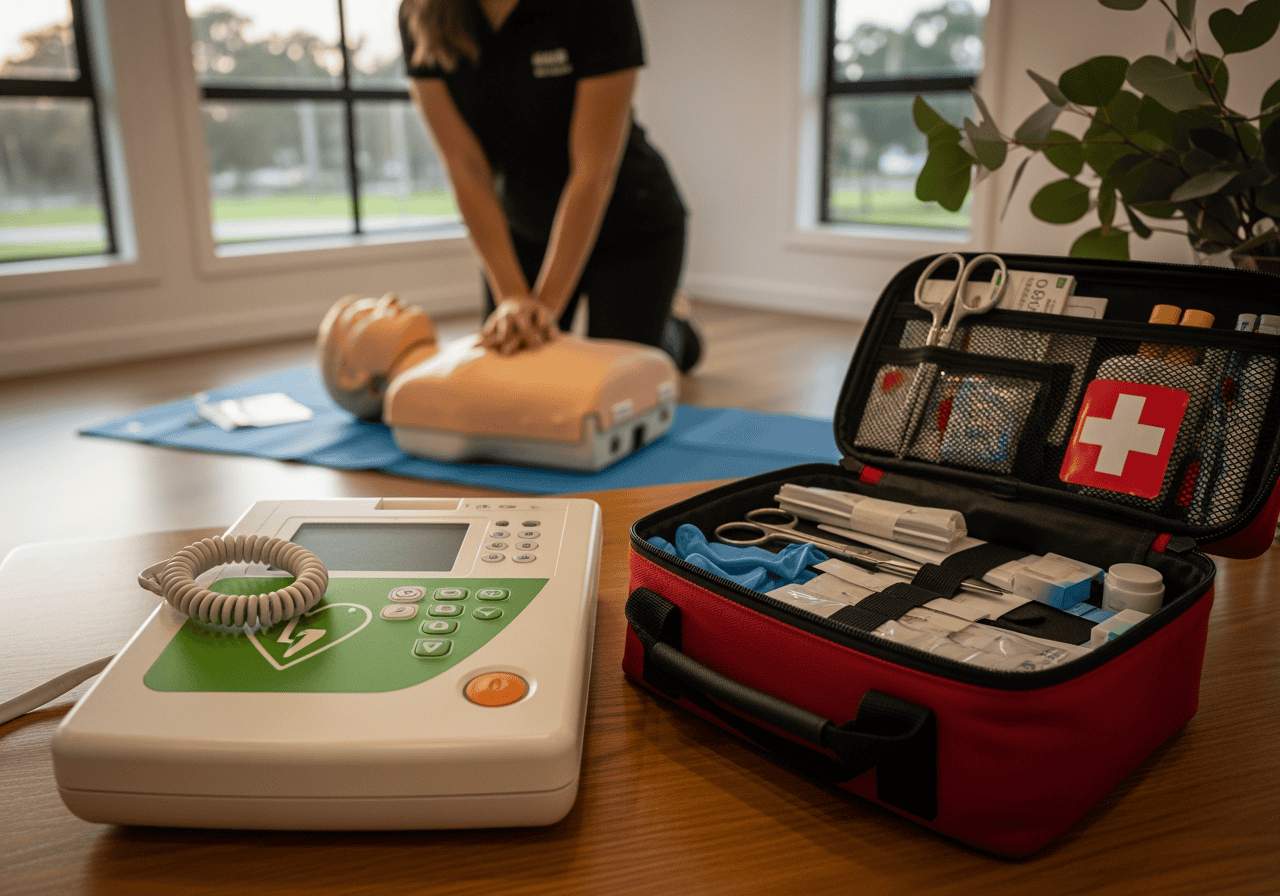
Selecting and maintaining the right first aid equipment begins with a site specific risk assessment so kits and Automated External Defibrillators are tailored to the hazards your workers face. Standard kits are suitable for low risk office environments, but higher risk worksites may need additional burn, eye wash, or trauma supplies and multiple strategically located kits. AEDs must be accessible without delay, housed in clearly signed cabinets and regularly checked for battery and pad expiry, with consideration given to weatherproofing for outdoor locations and secure mounting for high traffic areas.
Consistent inspection, restocking and record keeping are essential to demonstrate due diligence under WHS obligations. Paper checklists are easily lost or out of date; digital workflows reduce gaps by automating inspection schedules, capturing time stamped evidence of checks and generating restock alerts before items expire. AiDials AI voice solutions can streamline these tasks by enabling hands free inspection capture, automated reminders for servicing and consumable replacement, and centralised audit trails so compliance documentation is always current and accessible.
AED readiness is a critical business outcome because rapid defibrillation greatly improves survival rates for cardiac arrest and reduces liability exposure. Organisations should map AED locations, ensure designated responders are trained and practise retrieval scenarios to optimise response times. By integrating AED maintenance and location data into an AI driven asset management workflow that is processed and stored under Australian Data Sovereignty, businesses keep sensitive incident information secure, meet regulatory expectations and build trust with staff and clients while reducing downtime and overall risk.
Record Keeping, Refresher Training and Compliance Documentation
Maintaining detailed, accurate training records is a fundamental part of demonstrating due diligence under WHS law. Records should capture participant names, job titles, dates of training, course codes and versions, trainer or assessor details and accreditation numbers, assessment outcomes and any competency gaps identified. It is also important to record practical details such as AED or first aid kit checks conducted during training, equipment used and any scenarios or workplace-specific hazards covered. These records support compliance inspections, insurance claims and internal audits, and they help managers identify skills shortfalls across teams. AiDial’s AI voice solutions can automate much of this administrative work by logging attendance via voice-enabled check-ins, creating timestamped transcripts of training-related calls, and integrating entries directly into learning management systems. Because AiDial processes and stores data exclusively on Australian soil, those records remain under Australian data sovereignty, which reassures regulators and clients that sensitive staff and incident information is protected to local standards.
Refresher training prevents skill erosion and ensures staff remain confident to respond to first aid incidents. Common currency expectations in Australia include annual CPR refreshers and full first aid renewals typically every three years, though industry and site risk may require more frequent updates. An effective programme maps training cycles to job roles and high-risk areas, prioritising workers who face higher exposure to hazards. Automated scheduling reduces the administrative load and cuts the risk of lapsed certifications. AiDial can send proactive reminders and confirm attendance through automated voice calls or integrated SMS and calendar notifications, freeing safety teams to focus on higher value tasks. By tracking competency expiry in real time and coordinating cohort bookings, AiDial helps organisations optimise training budgets, maintain consistent coverage across sites and reduce business risk associated with gaps in first aid capability, all while keeping reminder and enrolment data securely hosted in Australia.
Incident documentation must be thorough, timely and easily retrievable for investigations, workers compensation claims and regulator enquiries. Best practice records include a clear narrative of events, witness statements, photographs or attachment links, first aid treatment provided, equipment used, follow-up actions and any notifications to health or safety regulators. Chain of custody for incident evidence and a clear audit trail are essential when demonstrating the organisation acted reasonably and in line with WHS obligations. AiDial streamlines incident logging by capturing voice reports, converting them to searchable transcripts and attaching them to the relevant personnel files or incident records. Crucially for Australian businesses and government contractors, AiDial processes and stores this information solely on Australian servers, ensuring data sovereignty and simplifying compliance with local privacy laws and procurement requirements. That secure, onshore approach increases trust with staff, regulators and insurers while making audit responses faster and more defensible.



Conclusion and Key Takeaways for Australian Workplaces
Workplace first aid is both a safety imperative and a legal obligation under Australian WHS laws. Start with a practical risk assessment to determine the number and type of trained personnel, then choose accredited training that aligns with those risks. Ensure all staff know essential skills such as CPR, bleeding control and shock management, and that your workplace has correctly stocked first aid kits and maintained AEDs. Keep clear records of training, equipment checks and refresher dates to demonstrate compliance and to protect people and the business.
To make compliance simpler and more reliable, consider how AiDial’s AI voice solutions can support ongoing training, reminders and record-keeping while maintaining Australian Data Sovereignty so sensitive staff and health information is processed and stored onshore. Our systems can automate refresher training notifications, help manage enrolments for providers aiming to boost uptake and compliance, and even support related operational workflows such as recovering unpaid training fees via debt collection with AI voice to boost recoveries and handling international payments through foreign exchange services with Australian Data Sovereignty. If you want to reduce administrative burden, improve audit readiness and keep your people safer, Contact Us for a Consultation or Book a Demo.